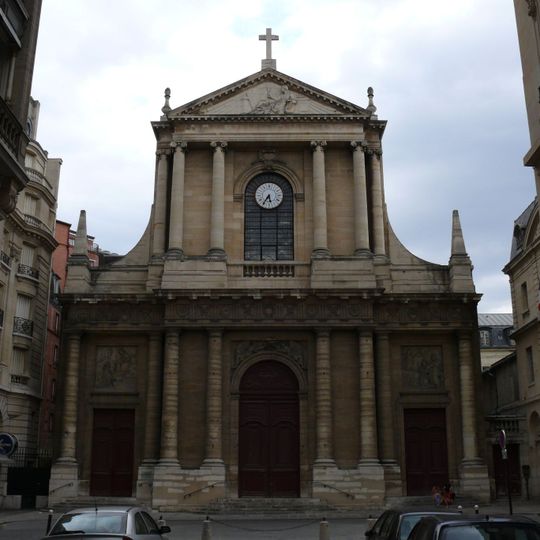
Église Saint-Thomas-d'Aquin, Roman Catholic church in 7th arrondissement, Paris, France.
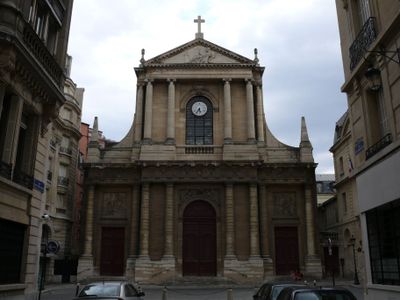
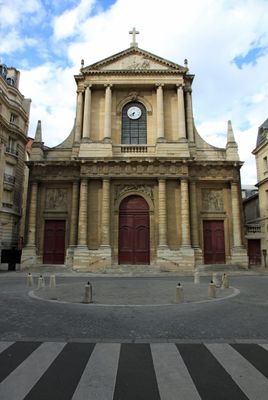
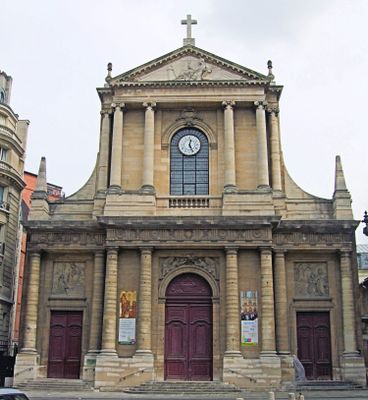
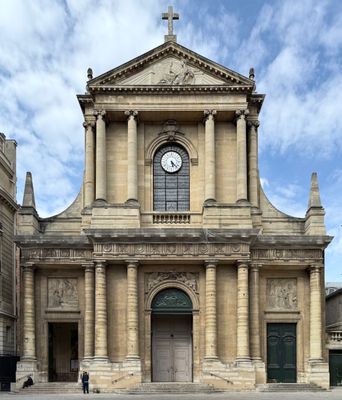
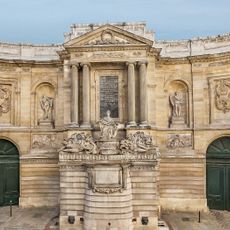
The church of Saint-Thomas-d'Aquin stands on place Saint-Thomas-d'Aquin between rue du Bac and boulevard Saint-Germain. Its classical facade, modelled on the Gesù in Rome, was built by the Dominican Claude Navan between 1765 and 1769: Doric columns below, Ionic above, and a triangular pediment whose relief La Religion, carved by François-Charles Butteux in 1769, shows Religion supported by Truth holding the tablets of the law. Inside, a barrel-vaulted nave is divided from the side aisles by round arcades on Corinthian capitals, and the choir holds a miniature classical temple over the altar.
A Dominican chapel was built here in 1632; the present church was begun in 1682 to plans by Pierre Bullet and consecrated in 1683 as Saint-Dominique. The friars' choir (now the Chapel of Saint Louis) was added in 1722, the novitiate in 1735–1739, and the portal in 1770. In 1793 the friars were expelled; the church became a Temple of Peace in 1797, then a Jacobin meeting hall, and was returned to Catholic worship in 1802.
The Chapel of Saint Louis, behind the altar, was built in 1722 as the friars' choir and commemorates the return of the Crown of Thorns to France, carried by two Dominican friars in 1239. Its ceiling carries François Lemoyne's 18th-century fresco of the Transfiguration, and Luc-Olivier Merson's 1887 painting shows Saint Louis rendering justice beneath an oak. A Guercino canvas, The Virgin Mary appears to Saint Jerome, hangs in the third bay.
The church stands on place Saint-Thomas-d'Aquin, between rue du Bac and boulevard Saint-Germain in the 7th arrondissement, a short walk from the rue du Bac metro station. The main entrance is through the central door beneath the pediment relief; the two side doors open onto the same facade. The building is an active parish, so visits are best planned outside mass times.
The Chapel of Saint Louis, built in 1722 as the friars' choir, commemorates the return of the Crown of Thorns to France, carried by two Dominican friars in 1239. Its ceiling holds François Lemoyne's 18th-century fresco "The Transfiguration", painted shortly before his similar ceiling at Versailles.
The community of curious travelers
AroundUs brings together thousands of curated places, local tips, and hidden gems, enriched daily by 93,277 contributors worldwide.