Église de la Mission de France, Catholic church in 1st arrondissement, Marseille, France
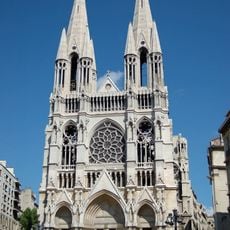
The Église de la Mission de France stands at 44 Rue du Tapis-Vert, its entrance connected to that street by the Jesuits in the 19th century. The tan stucco facade, designed in 1860 by cement worker Désiré Michel, is divided by fluted pilasters with ornate capitals and pierced by round and oval windows; a circular rose window with tracery sits below the centre, and two arched windows open above a small stone-balustraded balcony. A carved cartouche tops the large arched doorway.
The Lazarists, founded by Saint Vincent de Paul, built the church and adjoining buildings between 1648 and 1673, during Marseille's expansion under Louis XIV and Nicolas Arnoul. From 1791 to 1794 it served as Marseille's first official Protestant temple, leased after the 1787 Edict of Tolerance; the convent buildings were sold in 1795 but the church was kept. The Jesuits, invited by Bishop Eugène de Mazenod in 1839, rebuilt it from 1841 to 1865, and cement worker Désiré Michel made the present facade in 1860. Expelled in 1901, the Jesuits left a municipal building used as concert hall, masonry school and school-supply store until 1979; it was listed on 8 December 1965 and returned to worship in 1984.
Since 1984 the church has been entrusted by the City of Marseille to the Priestly Fraternity of Saint Pius X, which dedicated it to Pope Pius X; Mass is celebrated in the Tridentine rite. The parish launched Marseille's first sacred music festival, "Médiévances", held from the Sunday before Ascension to the following Sunday, with organ concerts ranging from Monteverdi to Naji Hakim; it ran for two years.
The church stands at 44 Rue du Tapis-Vert, in the 1st arrondissement near the old galley arsenal quarter, a short walk from the Vieux-Port. Its entrance was connected to Rue du Tapis-Vert by the Jesuits between 1841 and 1865, so approach from that street rather than the side lanes. It is municipal property and has been used for worship again since 1984.
The facade was designed in 1860 by cement worker Désiré Michel, not an architect; the Jesuits had the church rebuilt between 1841 and 1865 and linked its entrance to Rue du Tapis-Vert. The 1864 high altar has since been replaced by one taken from a side chapel of the former Saint-Martin church, demolished in 1887 when Rue Colbert was cut through.
The community of curious travelers
AroundUs brings together thousands of curated places, local tips, and hidden gems, enriched daily by 93,940 contributors worldwide.