La Canebière, Historic street in Marseille 1st arrondissement, France
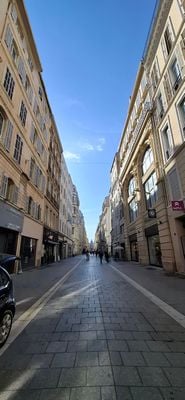
La Canebière is a straight avenue one kilometre long, running from the Église des Réformés down to the Vieux-Port; since 1927 it has absorbed the rue Noailles and the allées de Meilhan. Its width was fixed at 30 metres by the municipal council in 1857, and the rebuilt blocks from that campaign still line it. The roadway is paved with small dark grey stones laid in fan-shaped arcs, bordered by lighter flat bands and rows of trees, with tram rails set into the asphalt further along.
Construction of the street began in 1671 under King Louis XIV as part of a major expansion of Marseille toward the harbor. It represented the shift from the old port district to a modern, planned urban layout.
The name comes from the Provençal word for hemp, recalling when rope-makers worked in this area. Today the street hosts shops, cafés, and people from many backgrounds who give it its daily character.
The street is easily walkable and has several bus stops, with metro stations at Noailles and Vieux-Port nearby. The terrain is flat and good for strolling, with many spots to rest and observe the activity around you.
On 9 October 1934, King Alexander I of Yugoslavia was shot on La Canebière during a state visit; French foreign minister Louis Barthou was fatally wounded in the same attack. The killing was carried out by a member of the Internal Macedonian Revolutionary Organization, working with the Ustaše. A plaque and the trial that followed in Aix-en-Provence kept the event tied to the street.
The community of curious travelers
AroundUs brings together thousands of curated places, local tips, and hidden gems, enriched daily by 93,607 contributors worldwide.