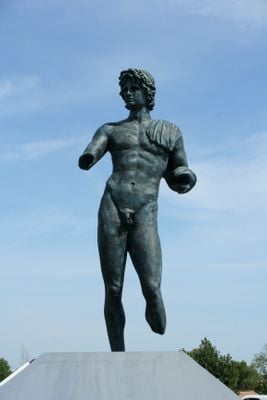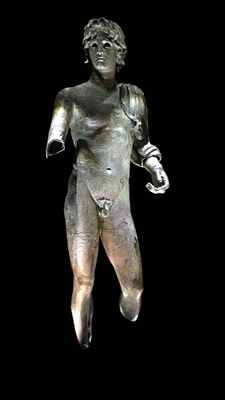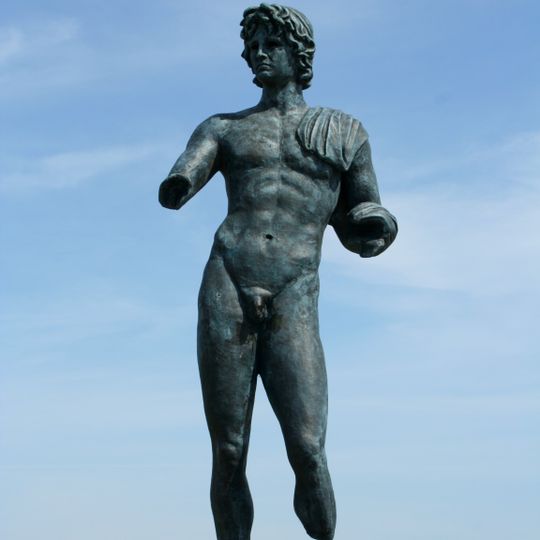
The Youth of Agde, Bronze statue at Musée de l'Éphèbe, Agde, France
The Youth of Agde is a bronze statue 1.33 m tall, dated to the 2nd century BC and kept at the Musée de l'Éphèbe in Agde. The nude youth stands on his right leg, head tilted, curly-haired, a cloth on his left shoulder; both arms are broken, the right above the elbow, the left at the forearm, and the feet are missing. The dark bronze has a mottled green-black patina.
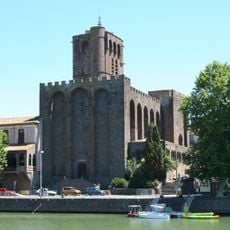
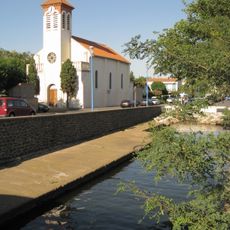
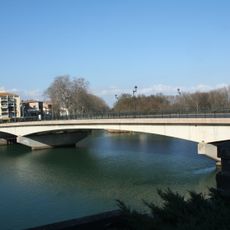
The bronze was found on 13 September 1964 in the bed of the Hérault facing Agde's Saint-Étienne cathedral by diver Jackie Fanjaud of the GRASPA. Dated to the 2nd century BC, it was restored at the Jarville-la-Malgrange metal laboratory and kept in the Louvre's storerooms for over twenty years. It entered the new Agde museum in 1987.
The left hand, found separately, showed the statue held a lamp: Romans used such nude-youth figures as lampstands lighting night banquets. Its style recalls Lysippos, court portraitist of Alexander the Great, and some attributes suggest the youth depicts Alexander himself. Agde adopted it as its emblem; a large resin copy stands on the Éphèbe roundabout.
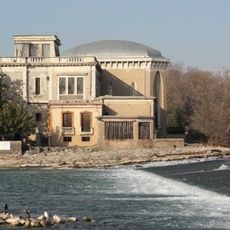
The statue is displayed in the Musée de l'Éphèbe et d'archéologie sous-marine in Agde, a building designed by architect Jean Le Couteur and inaugurated in 1985; the Éphèbe entered it in 1987. Look for the hollow open end of the right arm and the band around the left wrist.
The left hand, found separately, revealed the statue's function: it held a lamp, serving as a lampstand at Roman banquets. A resin copy stands on the Éphèbe roundabout near the southern bypass, and the statue appeared on a 1982 French postage stamp engraved by Czesław Słania.
The community of curious travelers
AroundUs brings together thousands of curated places, local tips, and hidden gems, enriched daily by 93,364 contributors worldwide.