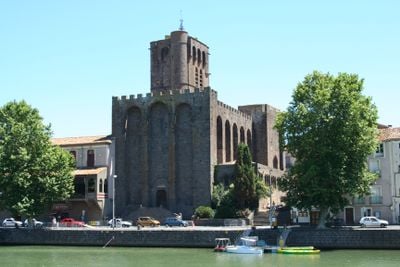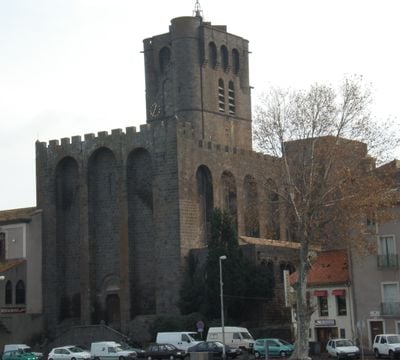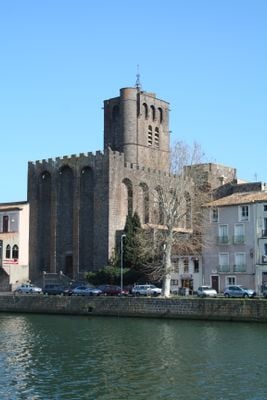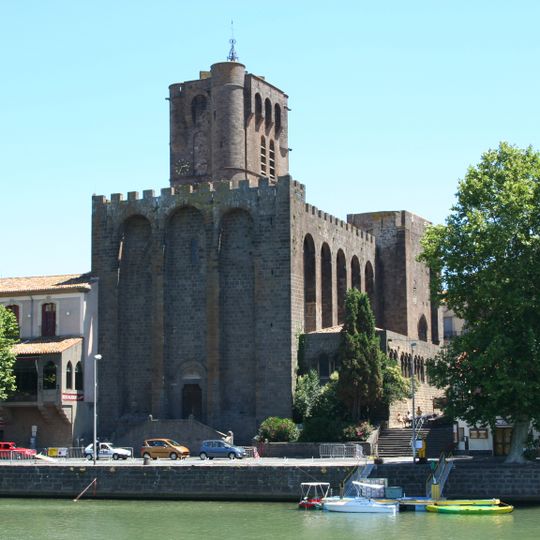
Agde Cathedral, Romanesque cathedral in Agde, France.
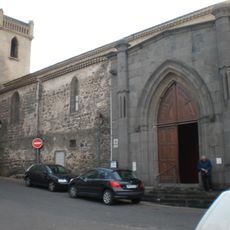
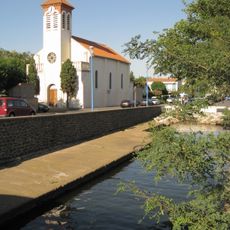
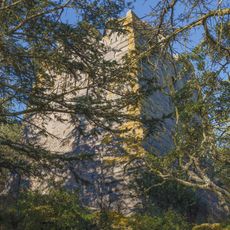
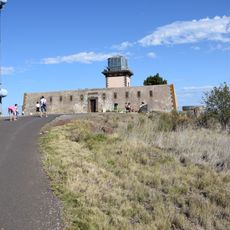
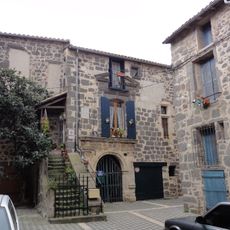
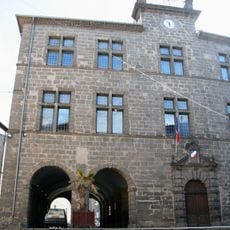
Agde Cathedral is a fortified Romanesque church built of dark basalt from the Mont Saint-Loup quarries. Its square tower rises 35 metres and is topped by a metal cross; the walls are 2 to 3 metres thick. The facade has three deep round-arched recesses and a row of crenellations, while a lower section to the right shows pointed arched windows and a round clock face.
Bishop William II began the present building in 1173 on the site of a 9th-century Carolingian church, itself raised on the foundations of a 5th-century Roman church. That Roman church stood where a temple of Diana had once been. The bishopric of Agde, founded in the 5th century, was suppressed after the Revolution: its last bishop was guillotined during the Terror, and the Concordat of 1801 attached its parishes to the Diocese of Montpellier.
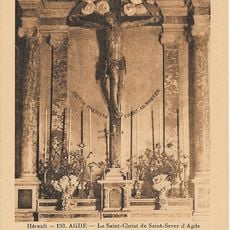
The colorful marble altar from the 17th century stands out against the stern interior, while baroque organs add layers of decoration that evolved over time. These ornaments show how the building's character shifted from fortress-like simplicity to greater embellishment.
The building sits in central Agde and is easy to walk to, with restaurants and shops nearby for convenience. Entry is free with no major restrictions, making it a simple stop during a visit to town.
The fifth bell, cast in 1665 by Damiac Fulcrand of Béziers, sits on top of the belltower rather than inside it and rings only for the clock; it has been a monument historique since 1959. The other four were cast by Burdin-Aîné of Lyon in 1894 and 1895.
The community of curious travelers
AroundUs brings together thousands of curated places, local tips, and hidden gems, enriched daily by 94,389 contributors worldwide.