Bon Sauveur, Psychiatric hospital and historic monument in Caen, France.
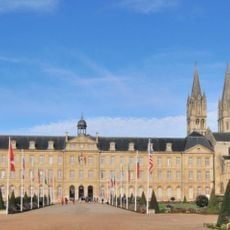
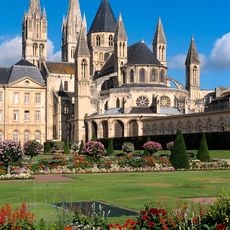
Bon Sauveur is a former Capuchin convent converted into a psychiatric hospital, with a symmetrical pale grey and cream stone facade, a dark slate roof and a tall central spire with a clock face above tall arched windows. The chapel was listed as a historic monument in 2006, and some buildings of the former men's quarter were listed in 2010.
Anne Le Roy founded the Association de Marie at Vaucelles in 1720; recognised by Louis XV in 1734 as the Filles du Bon Sauveur, the community moved to the former Capuchin convent at Saint-Ouen in 1804-1805. Under chaplain Pierre-François Jamet it became a departmental asylum in 1838, treating 1,439 patients by 1899, the third largest psychiatric hospital in France. In July 1942 the German occupiers evacuated it and installed a Kriegslazarett.
The name Bon Sauveur comes from the Congregation of the Filles du Bon Sauveur, recognised by Louis XV in 1734. The sisters took in women arrested by the police as well as Protestant converts, and from 1736 also women with mental illness. A chapel was built in 1775; the community was dispersed in 1792 and regrouped from 1805 in the former Capuchin convent at Saint-Ouen.
The site is an active psychiatric hospital, so access is limited to the exterior and the listed chapel; do not enter care areas. The chapel and the former men's quarter buildings are the inscribed elements, listed in 2006 and 2010 respectively. The complex lies on Rue Caponière, on the right bank of the Orne in the Vaucelles district.
The chapel's stained glass windows were designed by Gabriel Loire, an artist known for his modern interpretations of traditional techniques. These windows bring an unexpected artistic dimension to the space that is rarely found in such functional institutions.
The community of curious travelers
AroundUs brings together thousands of curated places, local tips, and hidden gems, enriched daily by 93,228 contributors worldwide.