Menhir du Manio, Prehistoric menhir in Carnac, France
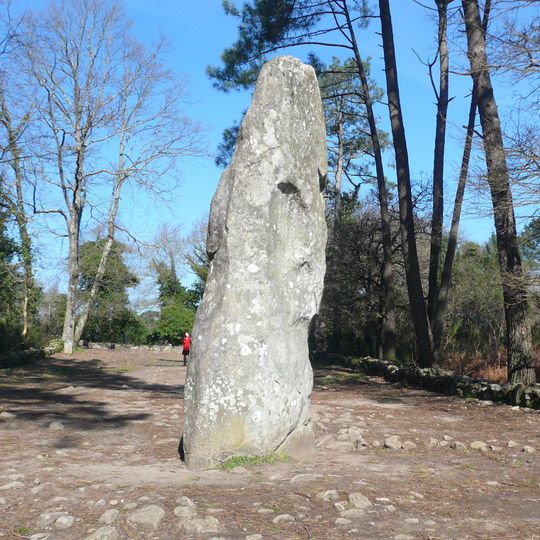
The Géant du Manio is a menhir of granite standing about 6.5 m tall, the largest standing stone in Carnac. It rises on stony ground north of the Manio alignment, roughly 50 m south of the Manio quadrilateral, which it serves as an indicator. Its pale grey surface is mottled with white and darker patches, with shallow hollows along its sides, and it tapers to a rounded top that recalls a head.
The stone was raised around 4500 years ago during the Neolithic period when communities placed thousands of these rocks across the landscape. This era defined Carnac as a place of major megalithic construction.
The name Géant du Manio comes from the stone's shape, which is said to recall a human head. It is also called Menhir aux serpents, the snake menhir, because engraved snakes were found at its foot. In 1922 five polished stone axes were uncovered during excavation at the menhir.
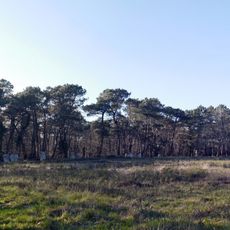
The menhir stands on a hill at Kerlescan, about 50 m south of the Quadrilatère du Manio and north of the Manio alignment, reached on foot from the surrounding megalithic paths. The ground at its base is bare and stony, so sturdy shoes help.
The stone's name comes from its shape, which resembles a head; this has led to the suggestion that it was once taller and was broken by lightning, with the fallen pieces later reused. Five polished stone axes were found at its foot during a 1922 excavation, and engraved snakes were discovered at its base.
The community of curious travelers
AroundUs brings together thousands of curated places, local tips, and hidden gems, enriched daily by 92,887 contributors worldwide.