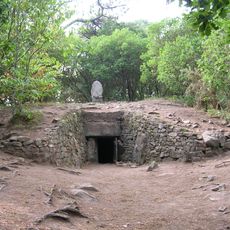
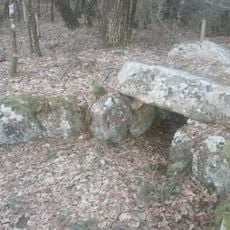
Quadrilatère du Manio, Neolithic monument in Carnac, France.
The Quadrilatère du Manio is a megalithic monument in Carnac made up of roughly 83 upright granite blocks arranged in a rectangular pattern. The formation extends about 37 meters long and 7 to 10 meters wide, with each stone standing about one meter tall.
The enclosure is the surviving kerb of a Neolithic tumulus, later topped by an old windmill that stood there when the site was excavated around 1890. That excavation cleared the mound completely without any result. The visible layout follows a restoration after the dig, matching neither an 1887 sketch nor G. de Closmadeuc's 1890 description to the Société polymathique du Morbihan. The quadrilateral, tumulus and Géant du Manio menhir were classed as monuments historiques in 1900.
The name Manio III links the enclosure to the Manio group, which also includes the Géant du Manio menhir about 50 m south. In 1781 a druidic order was founded in France, and the megaliths fuelled an esoteric craze that inspector Prosper Mérimée fought as a sect from 1836; the quadrilateral and menhir were listed as monuments historiques in 1900.
The enclosure lies on a hill north of Carnac, about 45 m north of the Géant du Manio menhir, which serves as a landmark for finding it. The stones stand in rough grass with fallen leaves, so sturdy shoes help on the uneven ground. The rows are open at both ends, letting you walk the length of the interior.
The visible layout is a late-19th-century restoration, not the original form: it matches neither an 1887 sketch nor G. de Closmadeuc's 1890 description of two adjoining enclosures, one 36 m long and a second of eight to nine stones. The mound inside was fully cleared in the 1890 dig, which found nothing.
The community of curious travelers
AroundUs brings together thousands of curated places, local tips, and hidden gems, enriched daily by 94,337 contributors worldwide.