Carnac stones

Log in to your account

AroundUs is a community-driven map of interesting places, built by curious explorers like you. It grows with every review, story, and photo you share.
Connect to save your favorite spots, contribute locations, and create personalized routes.
By continuing, you accept our Terms and Conditions and our Privacy Policy
Add to collection
Map
Suggest a change
Share

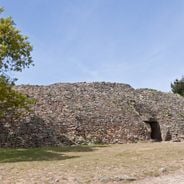
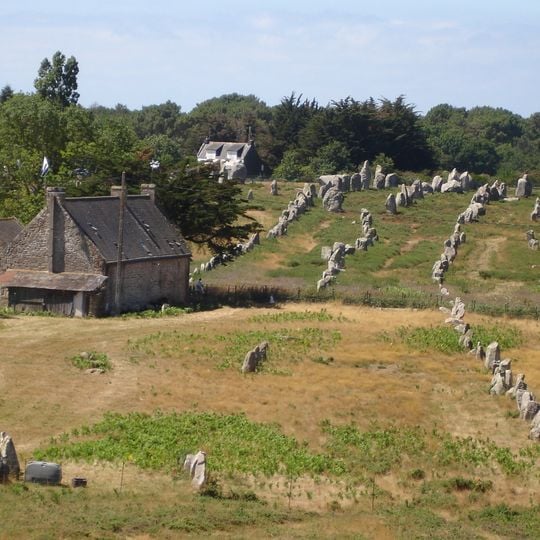
Carnac stones, Prehistoric stone alignment in Carnac, France.

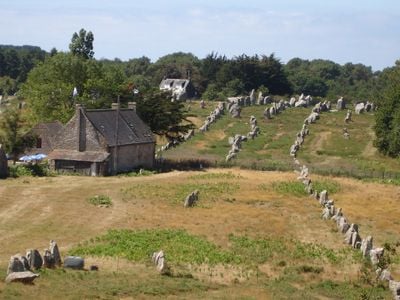
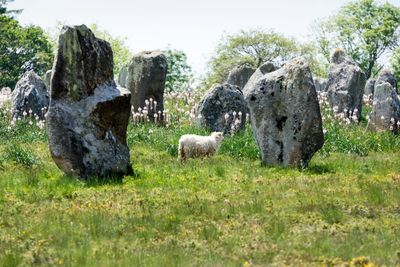
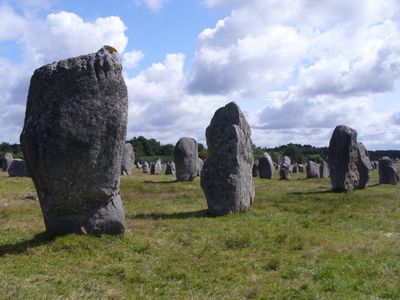
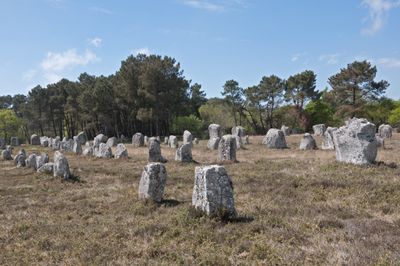
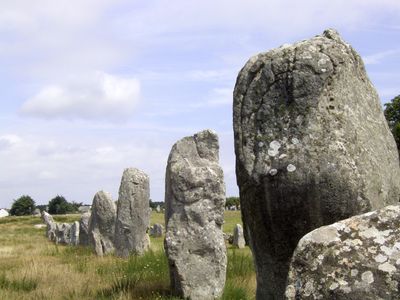
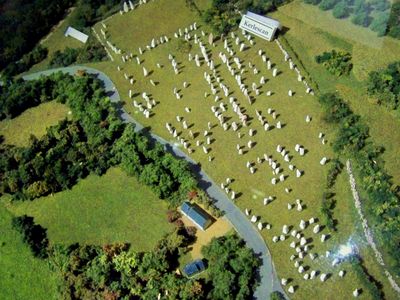
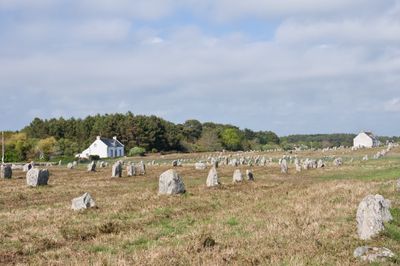
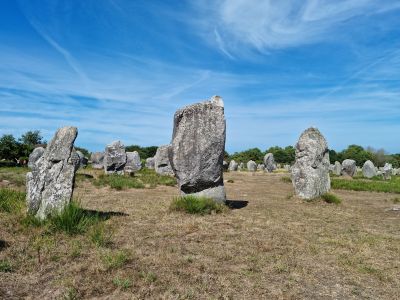
The Carnac stones are a megalithic site in Brittany on the French Atlantic coast, consisting of more than 3,000 upright granite blocks. These stones extend in parallel rows across roughly four kilometers and form several separate sections in the flat landscape near the shoreline.

The site was created between 4500 and 3300 BC by prehistoric communities during the Neolithic period in Europe. Later inhabitants sometimes used the stones as building material, and over the centuries some rows disappeared or were disrupted by farming and settlement.

Local stories describe these formations as Roman soldiers turned to stone by the wizard Merlin during his journey through Brittany. The oral tradition connects the site to medieval legend and remains part of how people in the region share the place with visitors today.

The site is freely accessible between October and March, while guided tours run during the summer months to protect the vegetation. Visitors can view the rows best from raised observation points or walk along marked paths outside the fenced areas.

The height of the stones gradually decreases from west to east, ranging from about 4 meters (13 feet) at the western end to less than one meter (3 feet) at the eastern finish. This gradation follows a clear pattern whose purpose has never been definitively explained.

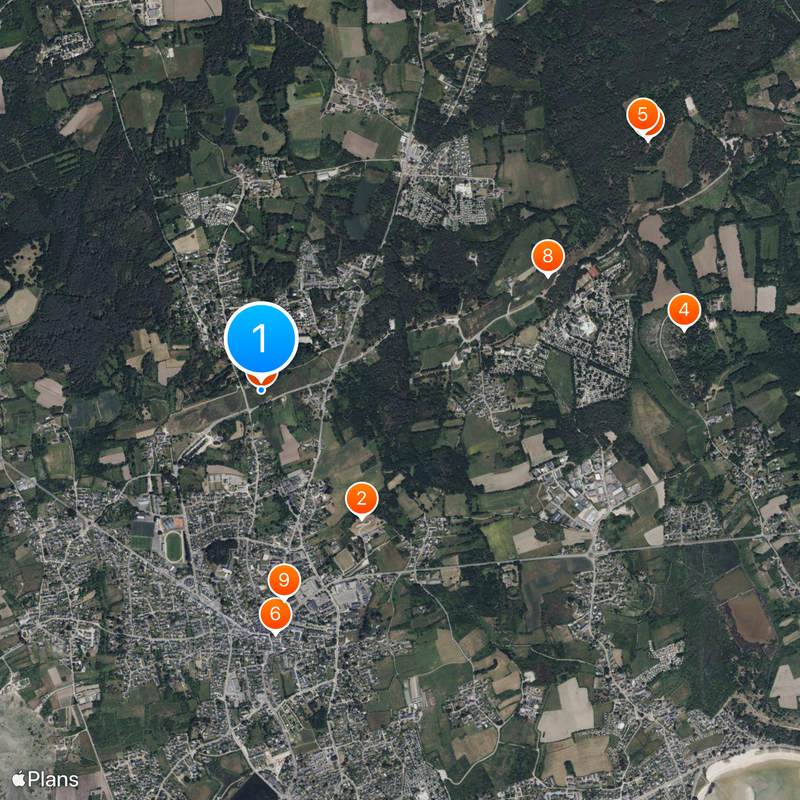
Location: Carnac

Location: La Trinité-sur-Mer

Address: LIeu-dit le Ménec, 56340 Carnac, France

Phone: +33297522981

Website: https://menhirs-carnac.fr

GPS coordinates: 47.59333,-3.07972

Latest update: December 2, 2025 21:18

Archaeological sites across the world

These archaeological sites document the development of human civilizations across thousands of years. They range from the earliest known temple structures like Göbekli Tepe in Turkey, dated to around 9500 BCE, to the preserved remains of Pompeii, frozen in time by a volcanic eruption in 79 CE. Each location offers insights into the technical abilities, religious beliefs, and social structures of past cultures. The collection includes monuments such as the Great Pyramid of Giza in Egypt, standing for over 4,500 years, and Machu Picchu in the Peruvian Andes, a 15th-century Inca stronghold at 7,970 feet (2,430 meters). In China, the Terracotta Army guards the tomb of the first emperor with thousands of life-size soldiers, while Angkor Wat in Cambodia represents the largest religious complex in the world. European sites like Stonehenge in England and the Acropolis in Athens demonstrate prehistoric engineering and classical Greek architecture. These places connect visitors to the societies that built them centuries or millennia ago.

Ancient stone monuments: sacred sites, temples, and structures dating back thousands of years

This collection encompasses ancient stone monuments and sacred sites from across the globe, ranging from the Easter Island Moai to the Great Wall of China. The structures represent millennia of human engineering and include religious temples, fortifications, burial sites, and astronomical installations. Many of these locations retain cultural significance for local communities today. Examples include prehistoric sites such as Göbekli Tepe in Turkey and Skara Brae in the Orkney Islands, alongside monumental constructions like the Parthenon in Athens, Angkor Wat in Cambodia, and the Pyramids of Giza in Egypt. The collection also features lesser known treasures including the Megalithic Temples of Malta, Nan Madol in Micronesia, and Great Zimbabwe. These sites provide insight into ancient cultures, religious practices, and architectural achievements that continue to draw visitors from around the world.

Stone circles: England, Scotland, Ireland, Germany and across Europe & USA

Stone circles stand among humanity's earliest architectural accomplishments, constructed by prehistoric communities across Europe and beyond over thousands of years. These circular arrangements of standing stones served multiple purposes, functioning as astronomical observatories where ancient peoples tracked celestial movements, seasonal changes, and solar events. The monuments also acted as communal gathering spaces for ceremonies, trade, and social activities. The engineering skills required to transport, raise, and position these massive stones—some weighing several tons—reveal the sophisticated organizational capabilities and technical knowledge of Neolithic and Bronze Age societies. This collection spans numerous locations throughout Europe. In England, Stonehenge features precisely arranged upright stones forming a 98-foot (30-meter) circle built between 3000 and 2000 BC, while the Avebury complex measures 1,086 feet (331 meters) across and dates to 2850 BC. Scotland hosts several significant sites, including the Callanish Stones with a central monolith standing 16 feet (4.8 meters) tall, and the Ring of Brodgar, which originally contained 60 stones encircled by a 30-foot (9-meter) wide ditch. The Castlerigg Stone Circle sits surrounded by Lake District peaks, constructed around 3000 BC. Beyond the British Isles, Germany's Goseck Circle demonstrates astronomical alignment dating to 4900 BC, making it one of the oldest known structures of its kind. Ireland's Drombeg Stone Circle uses 17 stones to mark solstice positions. Each site provides insight into how prehistoric communities observed the heavens, marked time, and organized their societies around these enduring monuments.

Photography locations in Carnac

The prehistoric sites of Carnac contain megalithic stones that extend for kilometers. The coastal location features sandy beaches, a marina, and historic buildings. The area includes stone alignments, dolmens, burial mounds, and natural coastal landscapes along the Brittany shore.

Reviews

Visited this place? Tap the stars to rate it and share your experience / photos with the community! Try now! You can cancel it anytime.

« Carnac stones - Prehistoric stone alignment in Carnac, France » is provided by Around Us (aroundus.com). Images and texts are derived from Wikimedia project under a Creative Commons license. You are allowed to copy, distribute, and modify copies of this page, under the conditions set by the license, as long as this note is clearly visible.

Discover hidden gems everywhere you go!

From secret cafés to breathtaking viewpoints, skip the crowded tourist spots and find places that match your style. Our app makes it easy with voice search, smart filtering, route optimization, and insider tips from travelers worldwide. Download now for the complete mobile experience.

Around Us App Screenshot

A unique approach to discovering new places

Le Figaro

All the places worth exploring

France Info

A tailor-made excursion in just a few clicks

20 Minutes