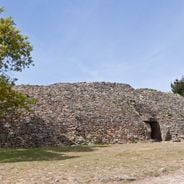
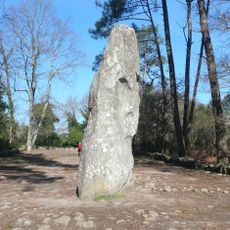
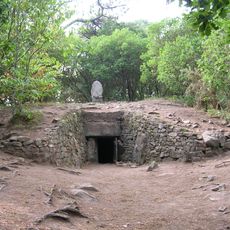
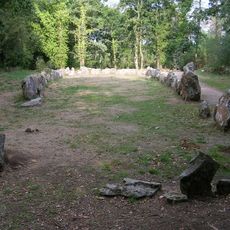
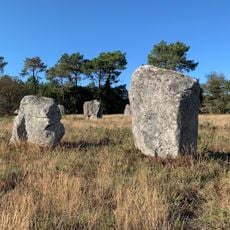
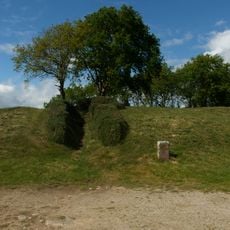
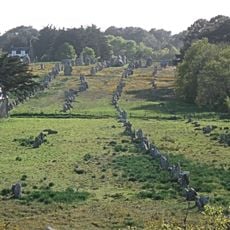
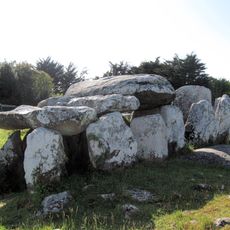
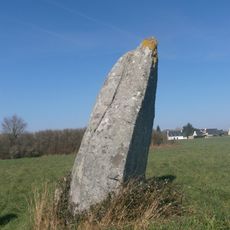
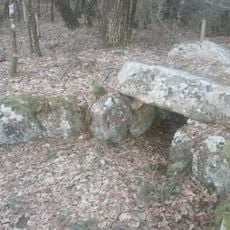
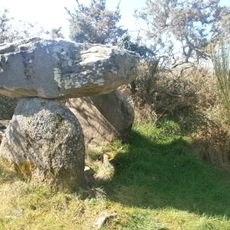
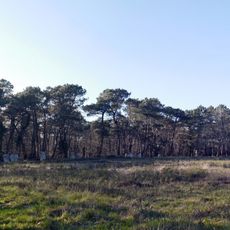
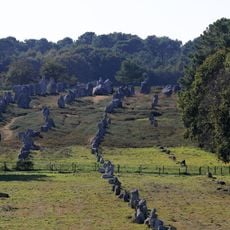
Kerlescan gallery grave, Neolithic gallery grave in Carnac, France.
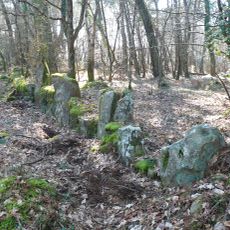
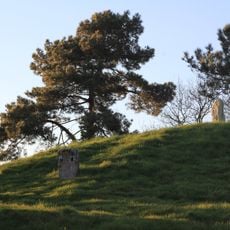
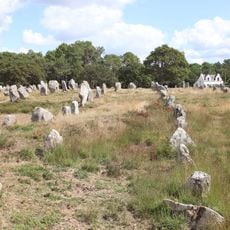
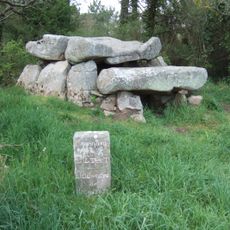
The Kerlescan gallery grave is a ruined gallery grave about 200 m north of the Kerlescan alignments, in woodland. Its roughly 60 m long, 8 m wide tumulus, edged by a stone kerb, holds a chamber once divided in two, with a soul-hole passage and a rare side entrance on the south; only one capstone remains, at the west end.
The structure was built around 3300 BCE as a burial site for early people living in Brittany during the Stone Age. This construction method shows the craftsmanship and social organization of that time.
The site sits within the famous Carnac stone complex and served as a burial place for early communities. Finds suggest that people of special importance were laid to rest here.
The monument lies about 200 m north of the Kerlescan alignments, in woodland, and is reached on foot from the surrounding paths. The chamber is largely open to the sky, with only one capstone left at the western end, and the floor is bare earth. Parts of the dry-stone walling were rebuilt during the restoration of about 1888.
Lukis, digging through Villemeureuil's spoil heaps, recovered two ornamented pots, a fibrolite axe, two arrowheads, a rock-crystal pendant and a schist pendant, now in the British Museum. Villagers told Gaillard that missing stones had gone into repairing the Moulin du Laz.
The community of curious travelers
AroundUs brings together thousands of curated places, local tips, and hidden gems, enriched daily by 93,688 contributors worldwide.