Villa Méditerranée, Archaeological museum and public building in 2nd arrondissement of Marseille, France.
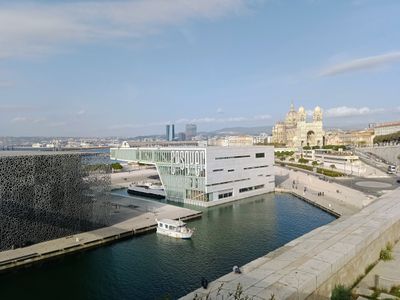
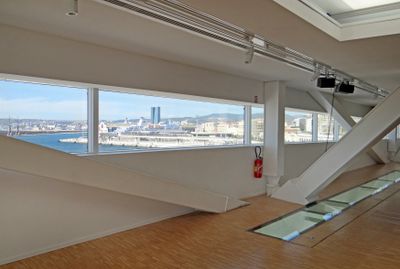
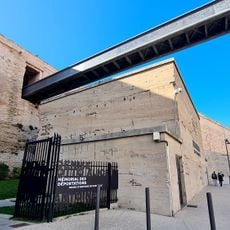
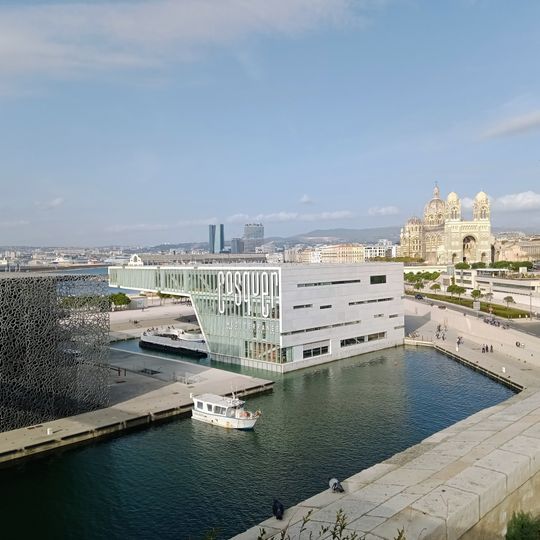
Villa Méditerranée is a public building on the J4 esplanade at Marseille's Joliette district, designed by Italian architect Stefano Boeri and inaugurated in 2013. Its inverted-L form is almost entirely surrounded by the sea, and a 40-metre cantilever housing a 760 m² exhibition floor projects 19 metres above a 2,000 m³ basin, carried by a column. Pale panelled facades with horizontal window bands face the water, and the projecting glass section bears the white lowercase lettering "vasco" and "musée méditerranée".
The building was completed in 2013 by Italian architect Stefano Boeri and marked a new turning point in Marseille's urban development. Its construction was part of broader efforts to transform the harbor and waterfront area for contemporary use.
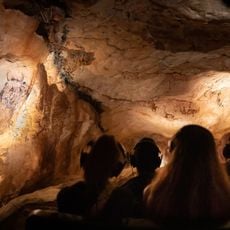
Since 4 June 2022 the building has housed Cosquer Méditerranée, whose centrepiece is a replica of the Cosquer cave, a Palaeolithic site. Visitors descend into a reconstituted decorated cave rather than viewing original artefacts. The name Villa Méditerranée came from the building's original role as a centre for dialogue and exchange on the Mediterranean, inaugurated during Marseille-Provence 2013.
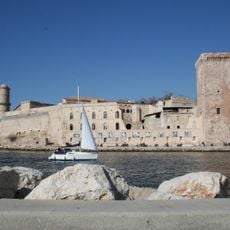
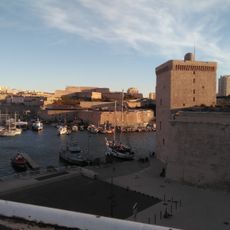
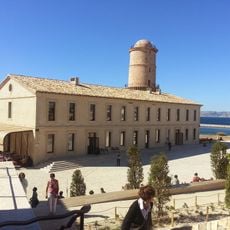
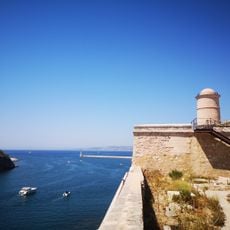
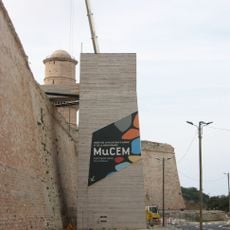
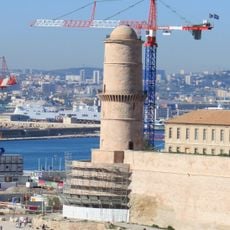
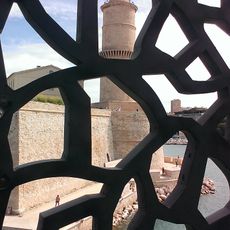
The building stands on the J4 esplanade beside Fort Saint-Jean and the MuCEM, almost entirely surrounded by water. A staircase links the esplanade promenade to the lower level. Capacity is limited to 500 people on level 2 and 250 inside the cantilever, so entry is regulated. The Villa closed in January 2018 and reopened in 2022.
The building's 40-metre cantilever, holding a 760 m² exhibition floor 19 metres above a 2,000 m³ basin, is described as the longest inhabited cantilever in the world. It earned the Villa nicknames such as "white elephant" and "stapler".
The community of curious travelers
AroundUs brings together thousands of curated places, local tips, and hidden gems, enriched daily by 92,922 contributors worldwide.