St John's Church, Wissembourg, Protestant church in Wissembourg, France
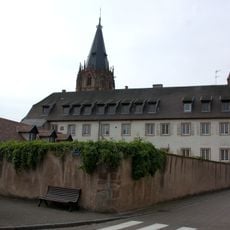
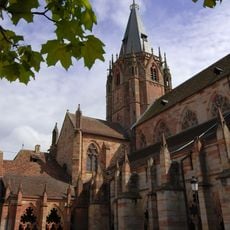
St John's Church in Wissembourg has a Romanesque tower from the early 13th century, topped by a steep grey slate pyramid. Its long nave, rebuilt around 1420, sits under a slate roof, and the pale plastered lower wall is pierced by pointed and round windows. A low green hedge borders the grass in front.
St John's was built between the 12th and 16th centuries, with a Romanesque tower from the early 13th century as its oldest part. Around 1520 the parish priest Henri Motherer bought its independence and called Martin Bucer, who preached the Reformation here from November 1522 to April 1523. In 1684 it became a simultaneum shared by Protestants and Catholics until Napoleon returned it to the Protestants in 1803. It was classified as a Historical Monument on 6 December 1898 and heavily damaged in World War II before being restored.
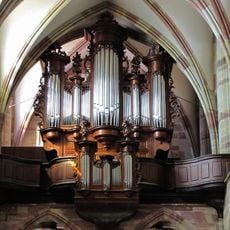
The church's name comes from John the Evangelist, and its square, Place Martin-Bucer, honours the reformer who preached here from November 1522 to April 1523. The south chapel holds a medallion of Bucer, while the north aisle has a 19th-century bust of Martin Luther. The 2015 Thomas organ, with 38 registers on three manuals, is lit by coloured LEDs that recall the bright paint of North German Baroque organs.
The church sits on Place Martin-Bucer and welcomes visitors interested in exploring its architecture. Regular Protestant services take place there, giving you a sense of how the space is actively used today.
The tower's clock is deliberately off-axis with the nave, likely aligned to an earlier building on the site. The 14th-century nave was later lowered under a modern ceiling modelled on the vestry's. Above the vestry, a room once served as a chapel and holds 14th-century murals restored in 1990.
The community of curious travelers
AroundUs brings together thousands of curated places, local tips, and hidden gems, enriched daily by 93,534 contributors worldwide.