Château de l'Esparrou, Historical castle in Canet-en-Roussillon, France
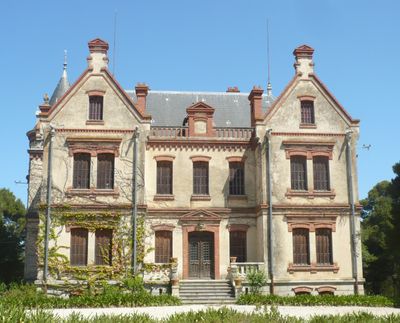
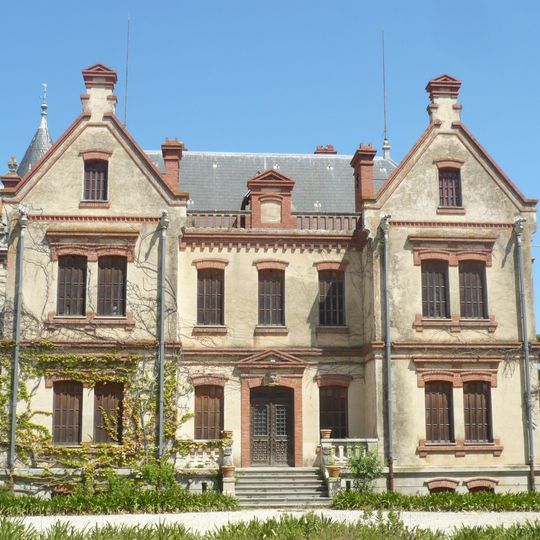
Château de l'Esparrou is a 19th-century building of 400 m² on four levels: an entresol holding the guard's apartment, a hunting room with a large fireplace, a laundry and outbuildings; then a ground floor with a great hall, vestibule, three bedrooms, dining room, library, music room and winter garden. Its pale facade has projecting gabled end wings, a recessed slate-roofed centre with a dormer, and a dark double door up stone steps. It faces the rising sun above the northeastern corner of the Canet-Saint-Nazaire lagoon.
The castle was built between 1889 and 1891 when Joseph Sauvy, president of the Perpignan commercial court, hired Danish architect Viggo Dorph-Petersen to design it. This era of industrial growth and wealth shaped the building's style and character.
The name comes from the Catalan esparra, a bar or wooden post closing a field, recorded in the 17th century as Lo Sparro and El Esparro. Claude Simon describes the building and its occupants' antics in Le Tramway (2001) without naming it; the site is also the penultimate tram stop before the beach. In 2017 the house served as Catherine Deneuve and Diane Kruger's home in Thierry Klifa's film Tout nous sépare.
The castle sits above the Canet-Saint-Nazaire lagoon and can be reached via departmental road D 81A. It is best to check current access conditions and opening times before planning a visit.
The name comes from the Germanic sparra plus the Latin suffix -onem, giving the Catalan esparra, a bar closing a field; in this spot it may have meant a boundary post, a wooden rail around a meadow, or the meadow itself. Claude Simon describes the building in Le Tramway (2001) without naming it.
The community of curious travelers
AroundUs brings together thousands of curated places, local tips, and hidden gems, enriched daily by 93,160 contributors worldwide.