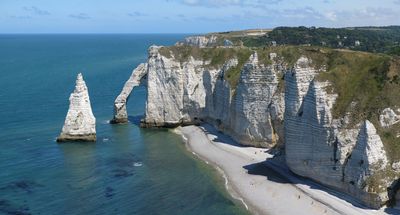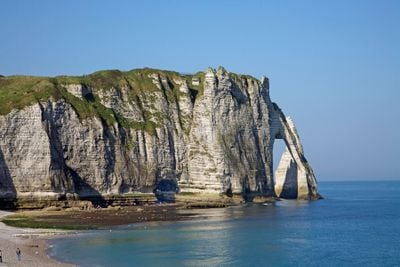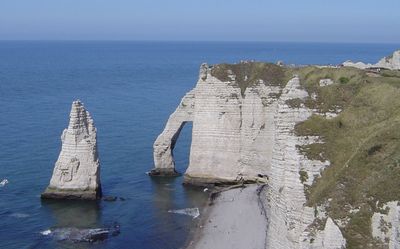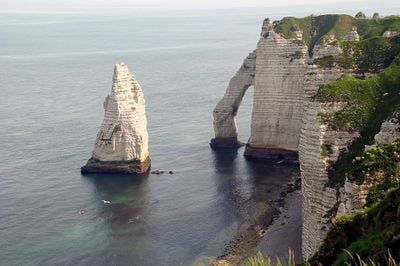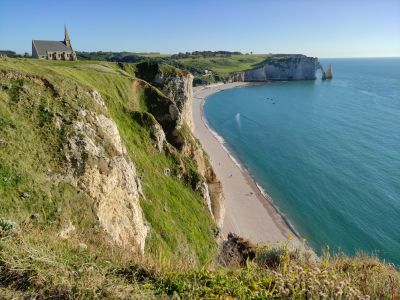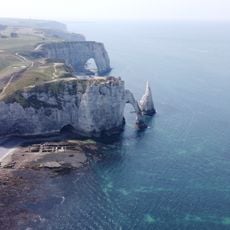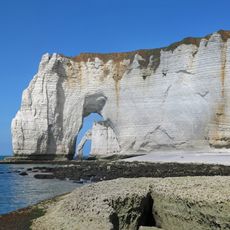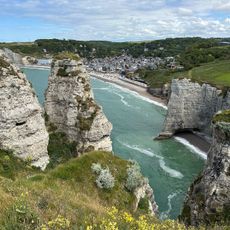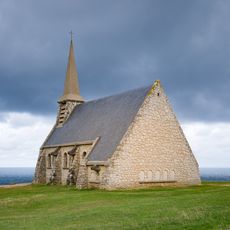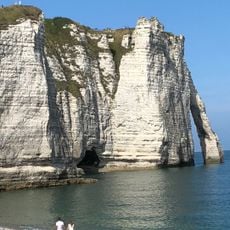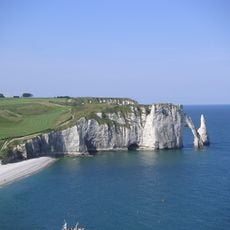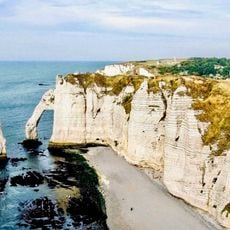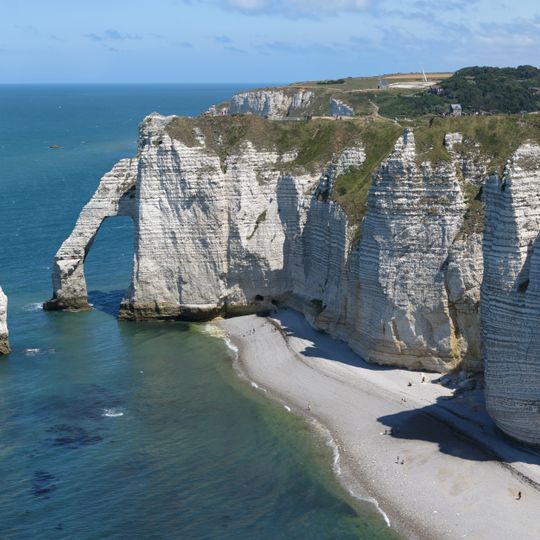
Porte d'Aval, Natural arch on the coast of Étretat, France.
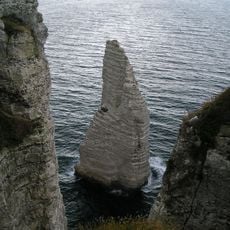
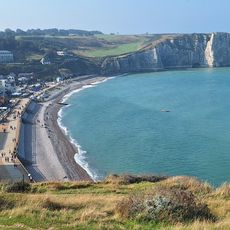
Porte d'Aval is a white chalk cliff pierced by a natural arch at its northern tip, about 100 metres out into the English Channel. The chalk is banded with brown-black flint layers, and the arch opens onto the sea above a pebble beach. West of the cliff stands the separate needle Aiguille d'Etretat.
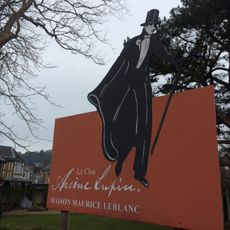
The chalk cliff and its arch were painted by Gustave Courbet, Henri Matisse and Claude Monet, who came to Étretat as the fishing village became an artists' destination in the 19th century. The arch later appeared in the Netflix series Lupin. In 2026 the Städel Museum in Frankfurt devotes a major exhibition to how Monet and others discovered this coast.
The arch's outline, likened to an elephant dipping its trunk into the sea, made it a repeated subject for Gustave Courbet, Henri Matisse and Claude Monet. It also appears in the Netflix series Lupin. The Städel Museum in Frankfurt devotes a 2026 exhibition to how Monet and others discovered this coast.
The arch stands at the end of a narrow grey pebble beach reached from Étretat along the coast; the beach is cut off at high tide, so time the walk to the falling tide. A footbridge from the top of the Porte d'Aval leads to the Chambre des Demoiselles cave, and the Trou à l'Homme opens in the eastern flank. Wear shoes for pebbles and chalk.
The arch is frequently compared to an elephant dipping its trunk into the sea, a poetic description that shaped how artists and writers interpreted the site. This imaginative comparison became central to how people understood and celebrated the formation.
The community of curious travelers
AroundUs brings together thousands of curated places, local tips, and hidden gems, enriched daily by 93,097 contributors worldwide.