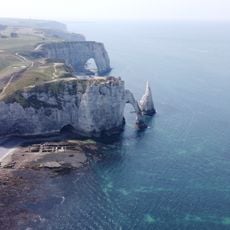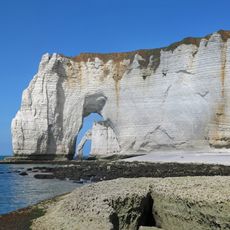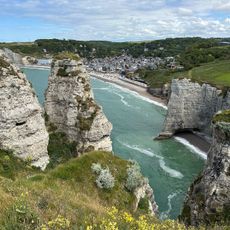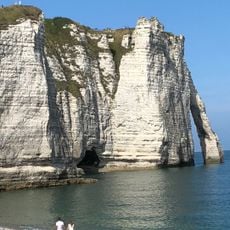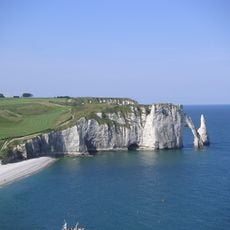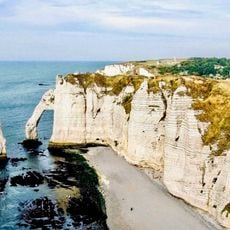
Aiguille d'Étretat, Natural rock formation at Étretat, France.
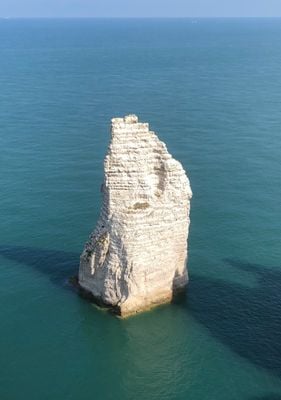
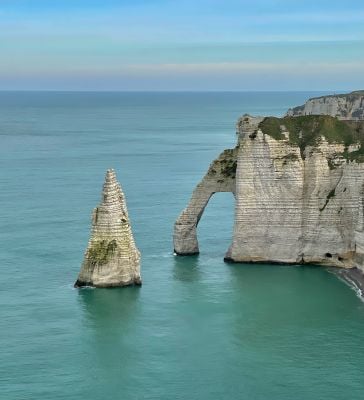
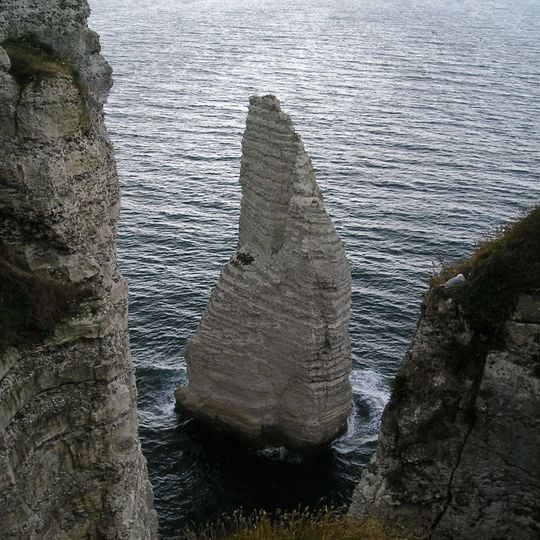
The Aiguille d'Étretat is a white chalk sea stack about 42 metres high and up to 30 metres across, standing roughly 50 metres west of the Porte d'Aval arch off Étretat. Its pale rock is crossed by thin horizontal bands of brown-black flint, and its surface carries centuries-old engravings.
The Aiguille d'Étretat is a chalk stack of the Alabaster Coast in Normandy, standing in the English Channel about 50 metres west of the Porte d'Aval, in the commune of Étretat (Seine-Maritime). It is a white chalk needle tapering upward, cut horizontally by brown-black bands of flint; its height is given as 42 metres, with some sources citing 51, and its maximum diameter is about 30 metres. Despite its slender look and exposed position, it has kept its present form for long periods, and centuries-old engravings are found on it.
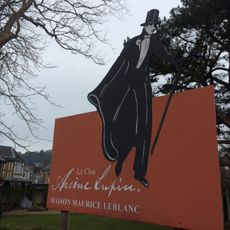
Claude Monet painted the Aiguille d'Étretat, and the needle appears in his canvases of the Normandy coast. In Maurice Leblanc's novels it serves as a secret hiding place for the master thief Arsène Lupin. The rock also carries centuries-old engravings on its surface.
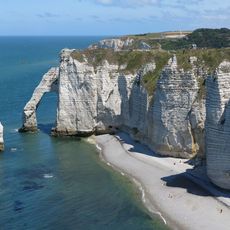
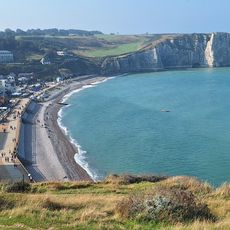
The needle stands about 50 metres west of the Porte d'Aval arch, in the commune of Étretat, Seine-Maritime. The GR21 coastal path runs along the clifftop between Bénouville to the north-east and Le Tilleul to the south-west, giving views of the stack from above. Boats leaving Étretat beach pass it at water level.
The needle's chalk is crossed by thin brown-black flint bands, and centuries-old engravings are cut into the rock itself. In Maurice Leblanc's novels the stack serves as a secret hiding place for the master thief Arsène Lupin.
The community of curious travelers
AroundUs brings together thousands of curated places, local tips, and hidden gems, enriched daily by 93,356 contributors worldwide.