Quelfennec, Archaeological quarry in Plussulien, France
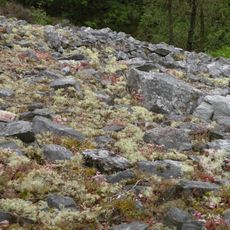
Quelfennec is a Neolithic dolerite quarry in Plussulien, Côtes-d'Armor. The rock face rises in stepped ledges of blocky grey stone, with darker boulders below and a broken ridge of lighter stones above; ferns grow at the base and moss patches sit in the crevices. The dolerite was worked for polished axes and adzes.
Charles-Tanguy Le Roux identified the dolerite quarry at Quelfennec in 1964, and excavation continued until 1976. The site was worked from about 3500 to 1800 BC, producing an estimated 5,000 polished axes a year, with output exported as far as Belgium and the British Isles. Production declined around 2000 BC as bronze tools spread.
The quarry served as a major production hub whose output was highly valued by distant communities. This wide distribution reflects how essential quality stone tools were for survival and daily tasks in prehistoric times.
The site is located in a rural setting and is best explored on foot with attention to uneven ground. Sturdy footwear is recommended, and visitors should be prepared for outdoor conditions that may vary throughout the day.
The tools produced here were instrumental in clearing vast forests across prehistoric Europe, fundamentally reshaping the landscape. This reveals how prehistoric communities used simple technology to transform their environment on a massive scale.
The community of curious travelers
AroundUs brings together thousands of curated places, local tips, and hidden gems, enriched daily by 93,855 contributors worldwide.