Oppidum de la Cloche, Archaeological site in Les Pennes-Mirabeau, France.
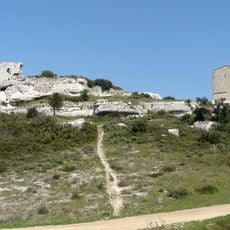
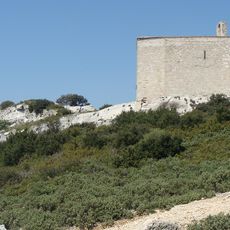
The Oppidum de la Cloche is a second Iron Age hilltop settlement on an advanced butte at the northern end of the Massif de la Nerthe, straddling the communes of Le Rove and Les Pennes-Mirabeau. Its dry-stone walls of irregular light-grey stones, now ruined and broken-topped, enclose two quarters reached by separate accesses: a small northern quarter by the ventilation tower and a larger summit quarter along the south-west crest. Excavated deposits have yielded human skulls and a seated warrior statue.
This fortified settlement was established in the 3rd century BC and was destroyed during Julius Caesar's siege of Massalia in 49 BC, serving as a crucial defensive position controlling the trade routes between the Étang de Berre and Marseille.
The summit area explored in the 1990s suggests a space used for worship. Among the finds shown at the Musée d'histoire de Marseille are human skulls that had been fixed above a door lintel, a practice of displaying defeated enemies' remains rather than a burial custom.
Two routes reach the site: one steep path by the ventilation tower to the small northern quarter, the other along the south-west ridge past an open glacis to the large summit quarter. The ground is uneven and the walls are ruined, so wear sturdy shoes. The summit gives a 360-degree view.
Among the remarkable discoveries is a fragment of a 3rd-century BC statue depicting a seated warrior with an engraved ring, which is now displayed at the Marseille History Museum and represents exceptional ancient artistic craftsmanship.
The community of curious travelers
AroundUs brings together thousands of curated places, local tips, and hidden gems, enriched daily by 93,896 contributors worldwide.