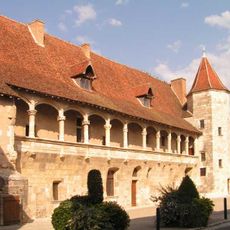
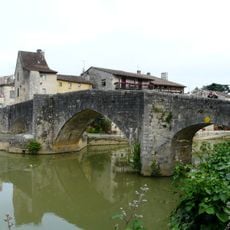
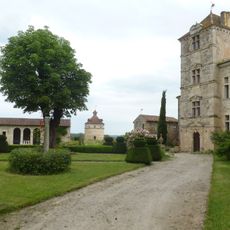
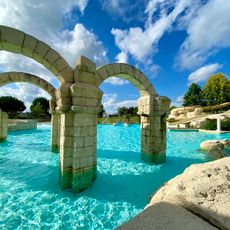
Ruines romaines de Nérac, Roman ruins in Nérac, France.
Ruines romaines de Nérac are the remains of a Gallo-Roman villa in the Garenne park, with mosaic floors of tan, dark grey and reddish-brown tesserae forming leaf and vine patterns. A curved section of mosaic runs along a pale greenish stone wall, and a patch of plain grey stone interrupts the pattern near the top right. The mosaics date to the 4th century.
Excavations in the Garenne park began in 1832 under M. Lespinault, joined in 1833 by Maximilien Théodore Chrétin. The villa's mosaics date to the 4th century, and its bath building was rebuilt along the Baïse at the end of that century. After Chrétin admitted forging inscriptions and bas-reliefs in 1835, digging stopped and the remains were reburied. Work on the Nazareth road and digs in 1966 and 1970 uncovered mosaic fragments over 45 metres, showing occupation from the 1st to the 6th century.
The mosaic floor, laid in tan, dark grey and reddish-brown stone tesserae, carries a repeating pattern of stylized leaves and curling vines. Sections were lifted and deposited at the town hall in 1986 and 1988, so what visitors see in the park today is partly a presentation of detached fragments. The name Garenne refers to the former castle park where the villa was found.
The site is located in Garenne Park and is accessible to visitors, with some mosaics also displayed at the town hall. The best time to visit is during dry weather to see the ruins and mosaics clearly.
During the original excavations of 1833, some finds were later identified as fraudulent, representing an early scandal in archaeological research. This case contributed to later investigations being conducted with greater scientific rigor.
The community of curious travelers
AroundUs brings together thousands of curated places, local tips, and hidden gems, enriched daily by 94,638 contributors worldwide.