Peyro-Lebado, Prehistoric standing stone in Lacaune, France
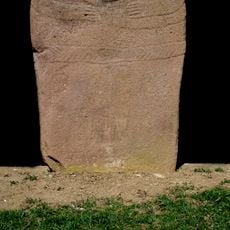
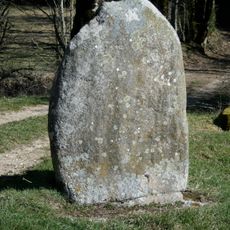
Peyro-Lebado is a granite statue-menhir 4.50 m tall (3.44 m above ground), 1.84 m wide and 0.67 m thick, estimated at 9.3 tonnes, standing on a meadow about two kilometres east of Lacaune near the D622. Its pale grey face is rough and lichen-covered, with a shallow rectangular depression near the upper right. Erosion has almost erased the carving, but a face, arms, hands, legs, feet, a belt with a chevron-decorated buckle, a shoulder strap and a garment can still be made out.
The menhir was erected by prehistoric communities and stood in place for thousands of years before being damaged. In 1825, an excavation attempt caused it to tilt, leading to its protection status being established in 1883.
The name Peyro-Lebado means "upright stone" in the local Occitan. The engravings are almost erased by erosion, but a belt with a buckle decorated with chevrons, a shoulder strap, a garment and the ring of the "object" can still be made out. The stone belongs to the Rouergat group of statue-menhirs, and the Lacaune and Rouergue area holds Europe's largest concentration of such stones, linked by a 40 km circular route.
The menhir is located near the RD 622 road and is relatively easy to access. Information panels on site explain details about the stone's history and importance.
Two notches about 20 cm above the carved belt may be marks left when the stone was straightened in 1883–1884 by the Tarn archaeological commission, after it had been reported fallen in 1865. The stone had already tilted in 1821 when a military engineer dug fruitlessly at its base.
The community of curious travelers
AroundUs brings together thousands of curated places, local tips, and hidden gems, enriched daily by 94,491 contributors worldwide.