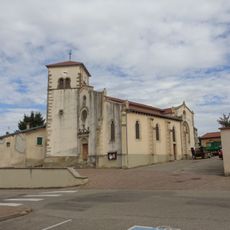
Pierre à cupules de La Verpillère, Cup-marked erratic boulder serving as war memorial base in La Verpillière, France
The Pierre à cupules de La Verpillère is a roughly parallelepiped block of Triassic breccia, over 80 tonnes, about 4 metres wide and 2 metres high, with pronounced angles. Its upper face carries many shallow but clearly visible cup marks. It now serves as the base of the town's war memorial, with a gilded statue standing above it.
The stone was excavated from the ground in 1919, at which time archaeologists discovered a burial site from the Copper-Bronze Age transition period beneath it. This finding greatly increased the stone's historical importance and eventually led to its official protection in 1926.
The stone bears marks left by people from prehistoric times, showing how they shaped their surroundings. These traces remain visible today and remind visitors of how long humans have used this location.
The stone sits centrally in La Verpillère and is easy to reach on foot, as it stands prominently in the town center as part of the memorial. Visitors can approach the site at any time without special preparation and examine the carved marks up close.
The burial found beside the stone in September 1919 held about fifteen bodies, some separated by layers of small stone slabs. The grave goods, now lost, were photographed and the prints kept at the Musée dauphinois in Grenoble: nine retouched flint blades, tubular beads of dark green stone, four deer-antler objects and a 0.50 m quern stone.
The community of curious travelers
AroundUs brings together thousands of curated places, local tips, and hidden gems, enriched daily by 94,441 contributors worldwide.