Château de Saint-Ouen, Neoclassical château in Saint-Ouen-sur-Seine, France
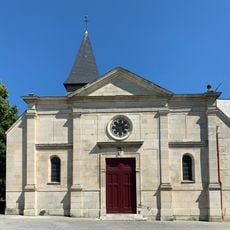
Château de Saint-Ouen is a three-storey neoclassical building of pale stone, built by Jean-Jacques-Marie Huvé from 1821. Its symmetrical facade has round-arched windows on the ground floor and rectangular windows with moulded surrounds above, and a projecting central portico with paired columns carries a stone balustrade. A low-pitched roof hides behind a stone parapet, with three tall chimneys rising above.
A first estate at Clippiacum existed under Charles VI, leaving no trace. In 1664 Joachim Adolphe de Seiglières de Boisfranc bought the seigneurie and had Antoine Lepautre build a new château between 1664 and 1669. Louis XVIII bought the estate in 1811; in the night of 2–3 May 1814 he signed the Declaration of Saint-Ouen there. In 1816 he had the old building demolished, and Jean-Jacques-Marie Huvé built the present château, whose first stone was laid on 8 July 1821.
The château's name comes from Saint-Ouen, the old village whose centre was the church of Saint-Ouen-le-Vieux. Under Séraphin Mauray, lord from 1640, two annual fairs were founded in 1642, including a pig fair held between the château meadow and the Seine on the last Sunday of August and on Saint Louis's day, 25 August.
The building now houses a municipal conservatory for music, theater, and dance instruction serving the local community. As a public cultural center, it operates with regular teaching programs throughout the year.
The château's furnishings were moved to Lorraine in the mid-19th century; the State later bought them back, and they may one day be shown again in the building. The estate once covered a terrace above the Seine, and its northern part is now the Parc des Docks de Saint-Ouen, opened in 2013.
The community of curious travelers
AroundUs brings together thousands of curated places, local tips, and hidden gems, enriched daily by 92,856 contributors worldwide.