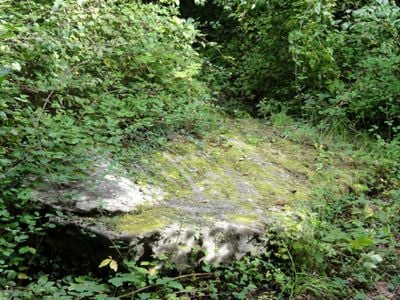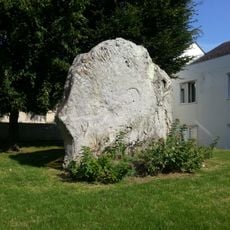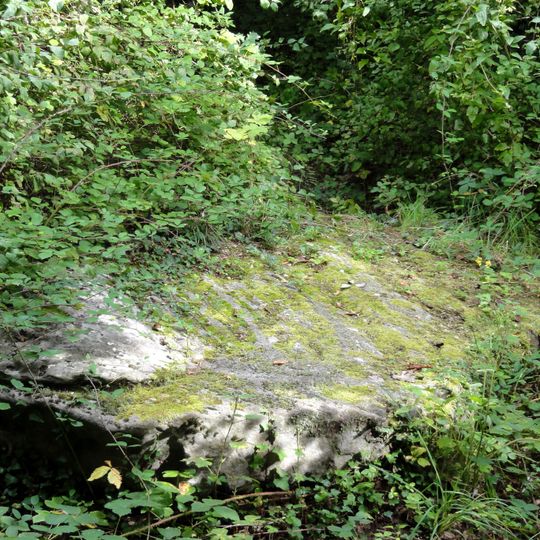
Grande Pierre de Jouy, Neolithic menhir in Jouy-le-Moutier, France.
The Grande Pierre de Jouy is a menhir of soft sandstone, a slab 3 m long, 2.55 m wide at the base and 0.90 m at the top, with a thickness of 0.50 m to 0.20 m. It lies completely flat on the ground in the Bois de la Vallée, its weathered grey surface patched with moss and lichen. No carving or inscription is visible on the stone.
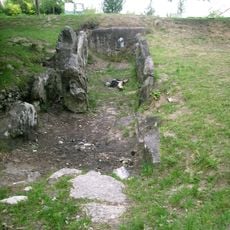
Amédée de Caix de Saint-Aymour (1843–1921) reported the stone in 1874, when it was still standing but strongly leaning; it has since fallen and now lies flat. It was classified as a monument historique in 1976. Nearby lie the Allée couverte du Cimetière aux Anglais and the Allée couverte de Dampont.
This sandstone megalith provides evidence of human settlements and construction techniques during the Neolithic period in Île-de-France. The monument represents one of the few preserved testimonies from this era in the region, documenting the technical abilities of early communities. Its preservation allows researchers to study prehistoric occupation of the Oise valley and the potential ritual or social functions of such structures during the Stone Age.
The site sits on a hillside at 66 feet (20 meters) altitude along the right bank of the Oise River, accessible via Les Grandes Pierres street. Visits are possible year-round as the monument stands in the open air. Visitors should wear sturdy footwear as the terrain may be uneven. The nearest public transportation options are in Jouy-le-Moutier, approximately 1.2 miles (2 kilometers) from the location.
The menhir lies in the Bois de la Vallée, north of Jouy-le-Moutier near Vauréal. Although it stands on a hillside at 20 m altitude on the right bank of the Oise, even when upright it could not be seen from the bottom of the valley. Close by lie the Allée couverte du Cimetière aux Anglais and the Allée couverte de Dampont.
The community of curious travelers
AroundUs brings together thousands of curated places, local tips, and hidden gems, enriched daily by 93,011 contributors worldwide.