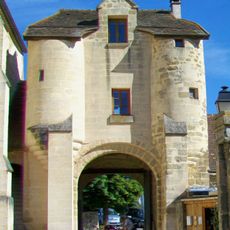
Église de la Nativité de la Sainte-Vierge de Jouy-le-Moutier, Romanesque church in Jouy-le-Moutier, France.
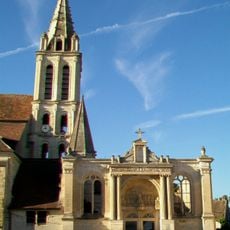
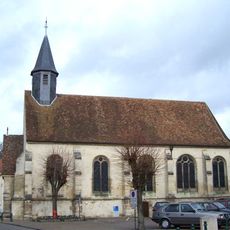
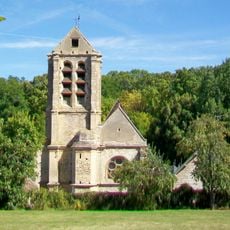
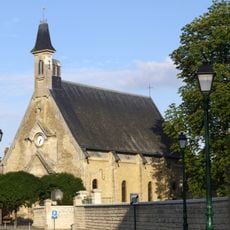
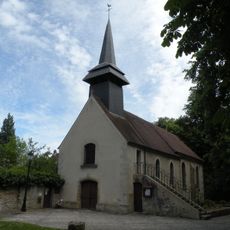
The Église de la Nativité de la Sainte-Vierge is a parish church on the Grande-Rue in Jouy-le-Moutier. Its oldest part is the central Romanesque bell tower, probably not much earlier than 1130, with two levels of bays and an octagonal stone spire. The tower rises above the crossing; its base was raised in the 16th century, and most Romanesque capitals were kept. The choir of the 1220s–1240s, influenced by Notre-Dame de Paris, is now unused, while the Flamboyant Gothic nave has large arcade capitals and open galleries with pierced balustrades.
The parish is first documented in 1186, when the church already stood. Its oldest surviving part is the central Romanesque bell tower, probably not much earlier than 1130; it was raised in the 16th century to link nave and choir. The choir was built in the 1220s-1240s under the influence of Notre-Dame de Paris. The church was classified as a monument historique on 11 December 1912.
The church was long known as Notre-Dame-de-la-Visitation before the parish adopted the title of the Nativity of the Virgin, celebrated on 8 September. Its second patron, Saint Loup de Sens (called Saint Leu in Île-de-France), is invoked by gardeners. A statue of Saint Gilles remains in a niche above the sacristy door.
The church stands on the Grande-Rue (RD 55) in the old village centre, near the town hall, on a hillside. About twenty steps climb from the street to the porch of the north facade; the west facade opens onto a small parvis reached without stairs, and entry is usually through the small north side-aisle door, the north portal being disused. A car park south of the church allows a full circuit, and the small public garden to the south-east gives the best view of the bell tower.
The 1993–1994 floor-heating works prompted excavations that revealed traces of buildings older than the 12th century. The central bell tower is the oldest surviving part, and only its four piers remain inside; the capitals at the crossing corners show the church was rib-vaulted from the start, as in Normandy and the Beauvaisis.
The community of curious travelers
AroundUs brings together thousands of curated places, local tips, and hidden gems, enriched daily by 93,134 contributors worldwide.