Menhir de Pierrefitte, Prehistoric menhir in Étampes, France
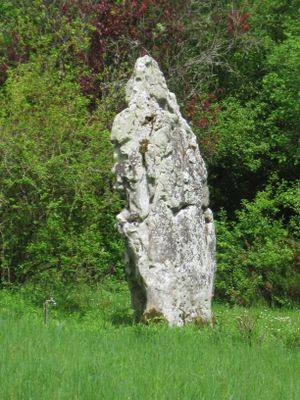
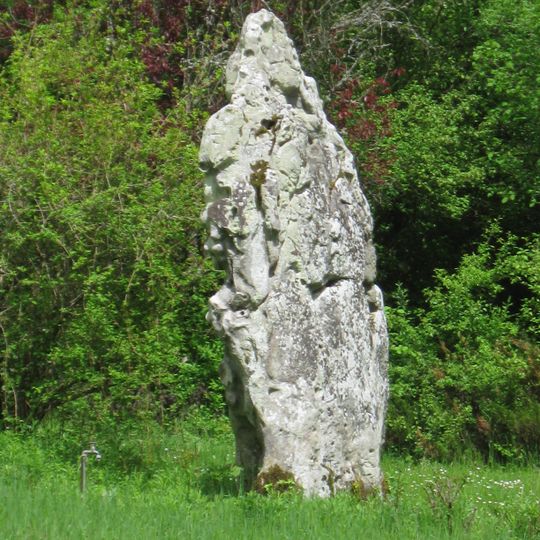
The Pierrefitte menhir is a 4.20 m tall slab of Stampian sandstone, 2.60 m wide at the base and 0.75 m thick, set in a private garden above the Louette valley. Its south-south-east face is fairly smooth, while the north-north-east face was partly smoothed and has natural holes. The block was quarried about a hundred metres away and is sunk roughly 1.60 m into the ground.
Early inhabitants of the region erected this monument during the Neolithic age. It received formal protection as a classified historical monument in 1964, marking its recognition as an important archaeological site.
This standing stone comes from an age when communities in the region performed rituals and erected stones to mark sacred ground. The practice reveals how early peoples expressed their beliefs and connection to the land through monumental stonework.
The menhir stands in a private garden, so it cannot be visited and is only glimpsed from outside. It overlooks the Louette valley; the nearest public viewpoint is along the surrounding lanes of the hamlet that bears its name. Do not enter the property.
The menhir gave its name to the neighbouring hamlet, which is also called Pierrefitte. The name comes from the Latin petra ficta, meaning "planted stone". The block is a slab of Stampian sandstone, and the outcrop it was cut from lies about a hundred metres away.
The community of curious travelers
AroundUs brings together thousands of curated places, local tips, and hidden gems, enriched daily by 93,165 contributors worldwide.