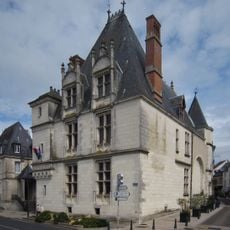
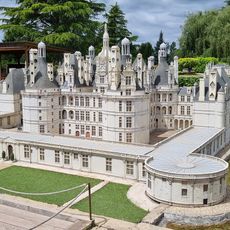
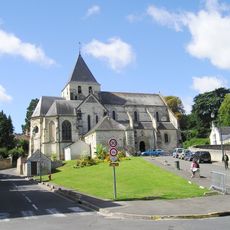
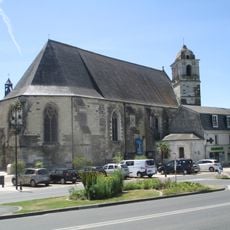
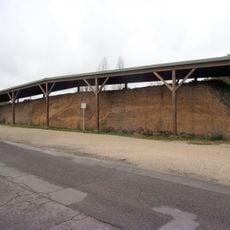
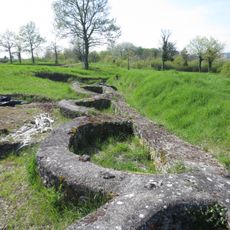
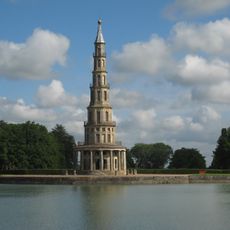
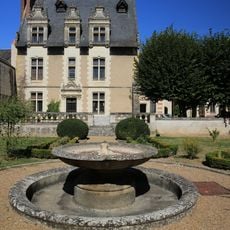
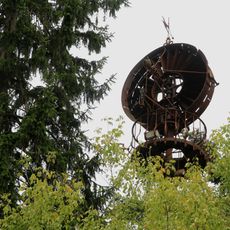
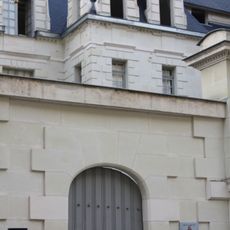
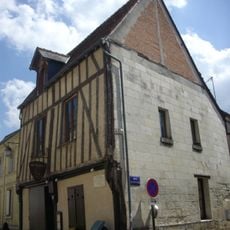
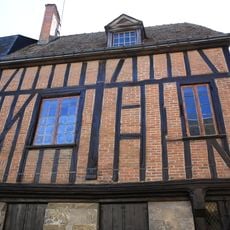
Greniers de César, Ancient granary in Amboise, France.
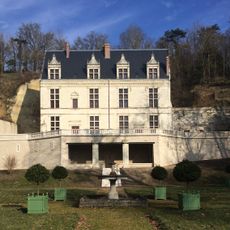
Greniers de César is a set of twelve wine cellars cut parallel into the tuffeau slope of the Châteliers plateau on the left bank of the Loire at Amboise. One of the three largest cellars runs 90 m and leads to four bell-shaped silos 4 m across and 6 m high, linked by an upper and a lower gallery; the lower one opens at courtyard level. The silos are lined with brick over a layer of sand.
The Amboise accounts record the digging of the silos in 1548 under Jean Gastignon, apothecary to the king's daughters, after Dominique de Cortone had left Amboise; Cortone had likely presented his plans before departing. In 1588 the Minims, who had a convent founded in 1493 just west of the caves, bought the hillside where the silos are cut. Around 1830 a corridor was pierced to link directly the base of the silos.
The name Greniers de César comes from a local tradition, possibly fed by Amboise's ancient past, that credits Julius Caesar with building the silos. In 1841 Jean-Louis Chalmel rejected that idea, and 1842 Étienne Cartier attributed them to the early counts of Anjou. The silos rely on carbon dioxide from the grain's own respiration to protect it from pests.
The chambers are accessible only through guided tours organized by the Amboise Tourism Office. It is best to book in advance and be prepared for narrow, cool underground passages.
The four silos are lined inside with brick, with a layer of sand between the brickwork and the tuffeau rock. Bernard Forest de Bélidor reproduced this arrangement in his 1737 Architecture hydraulique. A side staircase with a 22-metre drop links the galleries to the top of the slope, emerging just east of the castle moats.
The community of curious travelers
AroundUs brings together thousands of curated places, local tips, and hidden gems, enriched daily by 94,409 contributors worldwide.