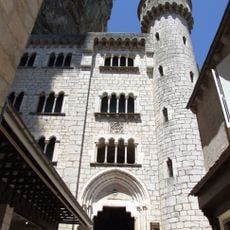
Notre-Dame de Rocamadour, Medieval chapel in Rocamadour, France.
Notre-Dame de Rocamadour is a chapel built against the cliff and the south wall of the Basilique Saint-Sauveur, constructed in limestone ashlar with a single nave, ribbed vault and a two-slope roof of flat tiles. Its south door, in Flamboyant Gothic style, bears the arms of Denis de Bar, bishop of Tulle, and above it is the coat of arms of his successor Clément de Brillac. The photograph shows a stone chapel on two levels, with a rounded-arch doorway and a smaller pointed-arch door linked by a diagonal staircase, and an upper balcony with a carved balustrade on corbels.
The chapel first appears in historical records in 1105 through a papal document from Pope Pascal II. Its prominence grew significantly after the discovery of Saint Amadour's remains in 1166, which attracted many pilgrims to the site.
The chapel's name comes from the black walnut statue of the Virgin, 76 cm tall, holding the child Jesus on her left knee; it was once covered in silver and restored after World War II and again in 2003. A bell older than the 9th century hangs from the vault, forged from a one-centimetre iron sheet, 24 cm high and 33 cm across. Ship models hang as ex-votos, among them a late-18th-century frigate and a 19th-century fishing schooner.
Reaching the chapel requires climbing many steps as it sits high against the rock face. Visit early in the morning or on cloudy days to avoid crowds and the intense heat of midday sun.
The bell hanging from the vault is older than the 9th century and was forged, not cast, from a one-centimetre-thick iron sheet; it measures 24 cm high and 33 cm across. Ship models hang beside it, including a late-18th-century frigate and a 19th-century fishing schooner, left as ex-votos.
The community of curious travelers
AroundUs brings together thousands of curated places, local tips, and hidden gems, enriched daily by 92,811 contributors worldwide.