Église de la Conception de Bastia, Historic Catholic church in Terra Vechja district, Bastia, France
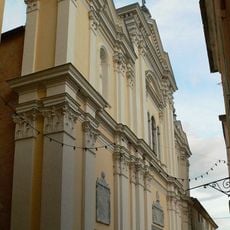
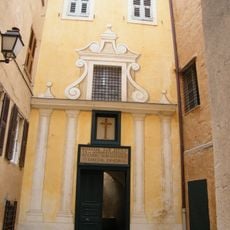
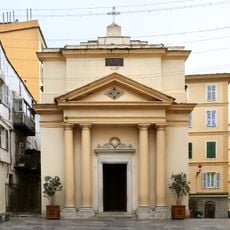
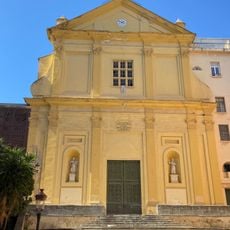
The Oratoire de l'Immaculée-Conception, called A Cuncezziò in Corsican, stands on rue Napoléon in the Terra Vechja district. Its flat light-grey stone facade has a triangular pediment with a stone cross and a small circular opening, a rounded arch niche above the carved entrance, and a sculpted panel with garlands. Inside, a tall nave has a dark gilded coffered ceiling with painted panels, red fabric panels between dark wood pilasters, and three crystal chandeliers; the white marble high altar is topped by a large framed painting.
The Confraternity of the Immaculate Conception was founded in 1588, and its chapel was completed in 1609. From 1636 to 1666 it served as the parish church of Terra Vechja while Saint-Jean-Baptiste was rebuilt. In 1795 it became the parliament of the Anglo-Corsican Kingdom, with a throne placed before the altar for King George III.
The walls are hung with silk damask, and the pilasters are covered with Genoese velvet from the late 16th century. Covering church walls with textiles is a Genoese custom, brought to Bastia in 1589 by governor Filippo da Passano. The walnut choir stalls were made in the late 18th century by several Bastia cabinetmakers.
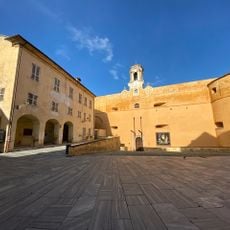
The oratory stands on rue Napoléon in the Terra Vechja district, a few steps from the place du Marché. The entrance is on the street side; the pebble mosaic parvis in front depicts the sun and the moon. The interior is entered directly from this parvis.
The building briefly served an unexpected political role when it was repurposed as a royal assembly hall in the mid-1790s. Visitors rarely learn about this unusual chapter in the site's local history.
The community of curious travelers
AroundUs brings together thousands of curated places, local tips, and hidden gems, enriched daily by 93,474 contributors worldwide.