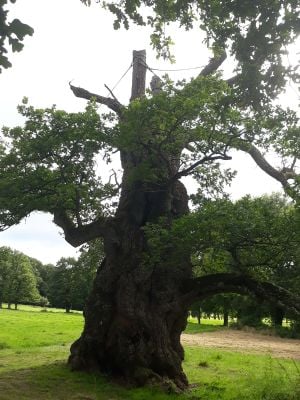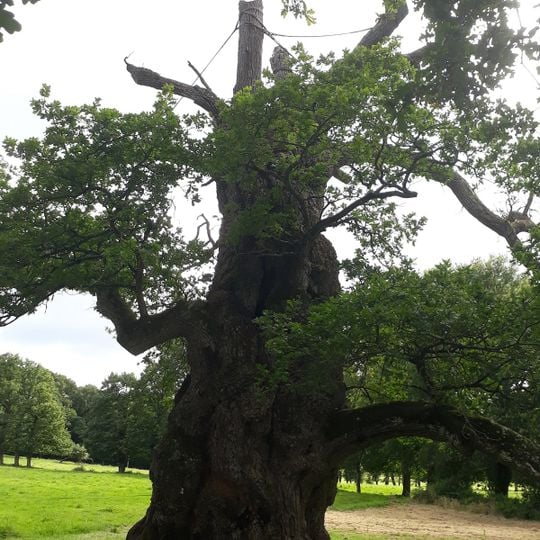
Chêne à Guillotin, Notable oak tree in Concoret, France.
Chêne à Guillotin is a hollow pedunculate oak standing alone just south of the hamlet of La Rue-Éon in Concoret, on the edge of the Paimpont forest. It rises about 16 m, its trunk measures 9.6 m in circumference, and its crown spans roughly 20 m. The opening in the trunk may have been made by 19th-century treasure hunters.
The oak's first literary mention dates to 1896, when Félix Bellamy linked it to priest Pierre Paul Guillotin, who hid liturgical objects there during the Revolution. The 1797 story of Father Joachim Masson and the spider's web belongs to a tree at Château-Gris in Mauron, under 4 km away; it was transferred to this oak after that tree was felled. Alain Cottin's 1979 guide fixed the name Chêne à Guillotin.
The name recalls a dark chapter when a priest sought refuge inside during the French Revolution. This connection to survival and sanctuary has made the tree a symbol of protection in local memory.
The tree stands south of La Rue-Éon hamlet and is surrounded by protective wooden barriers to prevent soil damage and root harm from visitor traffic. Staying on marked paths and respecting the barriers helps preserve the tree for future visitors.
The spider-web story belongs to the Château-Gris oak in Mauron, where the refractory priest Joachim Masson hid in September 1797; it was transferred to this tree only after that oak was felled. The tale reached the Rues-Éon oak through Alain Cottin's 1979 guide, which drew on Henri Thébault's tale and substituted Father Guillotin for Masson.
The community of curious travelers
AroundUs brings together thousands of curated places, local tips, and hidden gems, enriched daily by 94,532 contributors worldwide.