Tombeau des Géants, Gallery grave in Campénéac, France
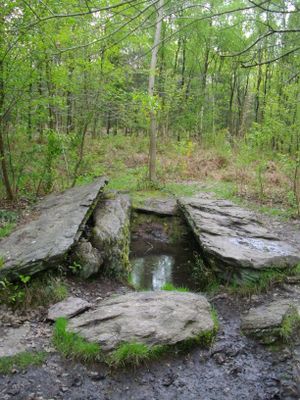
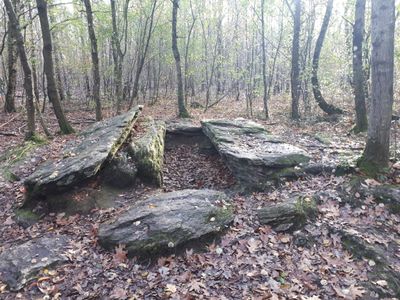
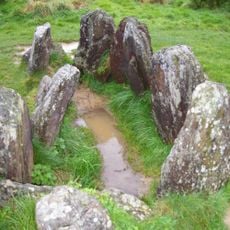
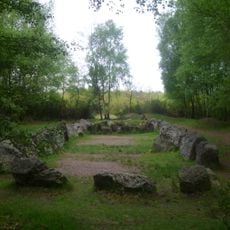
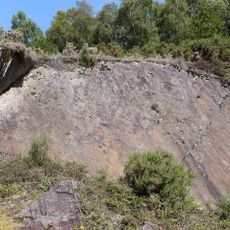
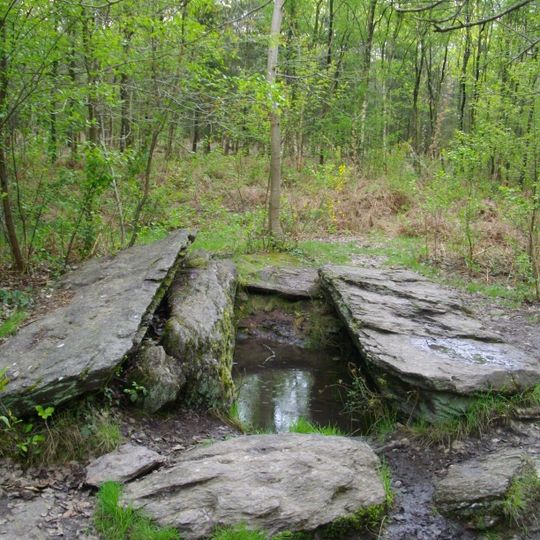
Tombeau des Géants is a prehistoric burial chamber in Brittany built from massive red schist blocks arranged in a rectangular shape. The main structure features large lateral slabs that form the central chamber, surrounded by a mound of quartz and schist stones.
Félix Bellamy described the monument in 1896 in La Forêt de Bréchéliant, and its state then was much as it is now. A dig around 1920, of unknown result, deepened the chamber floor by 0.15 to 0.20 m. Jacques Briard excavated in 1982 and argued that three of four north-south aligned menhirs, erected between 3000 and 2500 BC, were reused around 2000 BC as the two side walls and the cover slab.
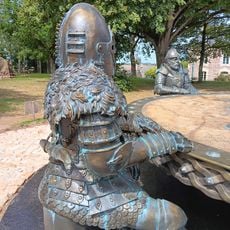
Local tradition links the tomb to Arthurian legend: it is said to be the grave of a giant defeated by the Knights of the Round Table. Félix Bellamy recorded in 1896 that the monument was also called Roche à la Vieille, after an old princess supposedly buried there; in folk tales the "old woman" often means a witch or Death itself.
The site is freely accessible from early April through mid-September near La Touche Guérin in Campénéac. It sits in a rural setting, so a car is helpful for reaching it, and you should allow time to walk around and examine the stones up close.
The fallen schist block about 8 metres west of the tomb is a toppled menhir, confirmed by Jacques Briard's 1982 excavation. Two socket holes at its ends show it was erected, felled, raised again in the second hole, then thrown down once more. It measures 4.25 m long and 0.70 m thick.
The community of curious travelers
AroundUs brings together thousands of curated places, local tips, and hidden gems, enriched daily by 94,143 contributors worldwide.