Butte de Tiot, Prehistoric burial mound in Campénéac, France
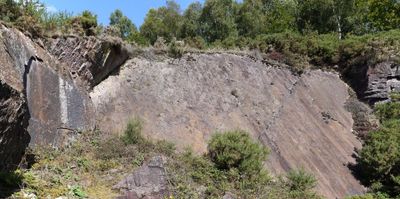
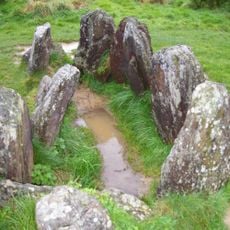
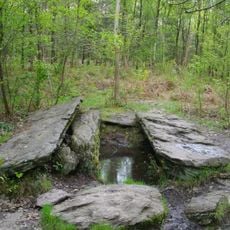
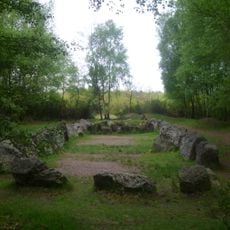
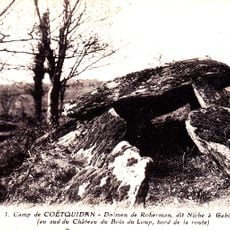
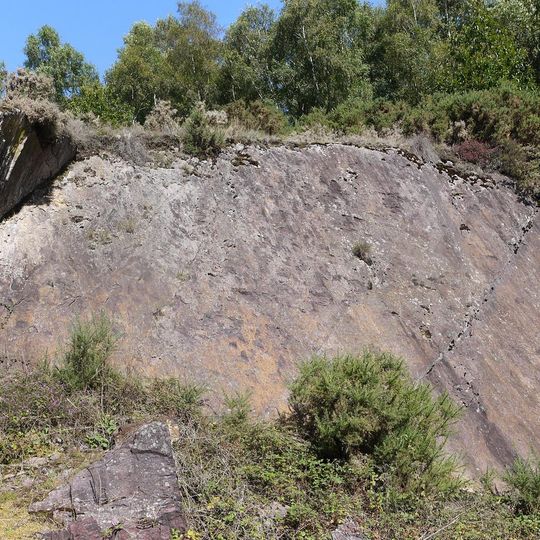
Butte de Tiot is a 190 m hill north of the hamlet of Le Lidrio in Campénéac, holding the remains of two Bronze Age tumuli in poor condition. One is reduced to a megalithic cist of schist slabs, covered by a thick, fissured purple schist plate still ringed by the rest of the mound. The broad, sloping rock face shows rust-orange and grey patches above darker blocky stones and shrubs.
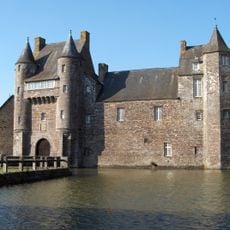
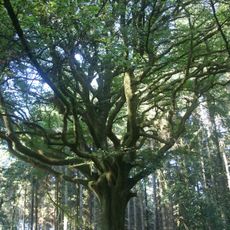
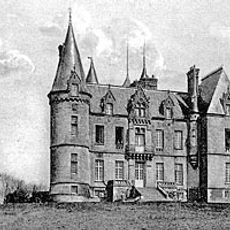
The two tumuli on the butte date from the Bronze Age, when the hill served as a burial place. They were discovered in the 1980s and studied by the archaeologist Jacques Briard. Analyses carried out then showed that the hill was already occupied and cleared of trees by people during the Bronze Age. The ensemble formed by the butte de Tiot and the château de Trécesson, with its accompanying oak avenue, has been a site naturel classé since 10 January 1967.
The site's name comes from the Breton word tiot, and the two damaged mounds sit on a hill that was already cleared of trees in the Bronze Age. One mound is reduced to a megalithic stone cist of schist, its thick cracked slab still visible. The butte and the oak avenue linking it to Château de Trécesson have been a protected natural site since 10 January 1967.
The butte lies about 3.7 km north-east of Campénéac's village centre, roughly 1.2 km north of the Château de Trécesson, in open ground reached on foot. The two tumuli are in poor condition: one survives only as a schist megalithic cist, so look for low stones rather than mounds. The site is part of a natural area classified since 10 January 1967, together with the château and its oak avenue.
The 1980s excavations by archaeologist Jacques Briard showed that the hill was already cleared of trees in the Bronze Age. The site, together with the Château de Trécesson and its oak avenue, has been a classified natural site since 10 January 1967.
The community of curious travelers
AroundUs brings together thousands of curated places, local tips, and hidden gems, enriched daily by 94,221 contributors worldwide.