Grotte des Fées, Natural cave entrance in Arcy-sur-Cure, France
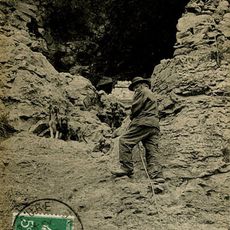
Grotte des Fées is a cave entrance in the Cure valley at Arcy-sur-Cure, cut along a near-vertical fissure that gives it a triangular porch, unlike the lintelled porches of the Grande grotte. Its rock is marl, harder than limestone, so the porch has stayed almost intact. The cave belongs to the Fées–Moulinot network, 2,820 m long, the longest natural underground cavity in the Yonne.
The marquis de Vibraye found a Neanderthal mandible here in 1859, two years after the first Neanderthal skull was identified, confirming that early humans had lived alongside extinct animals. Robineau-Desvoidy had dug here in 1853 and distinguished two layers. The cave was listed as a Monument historique in 1992.
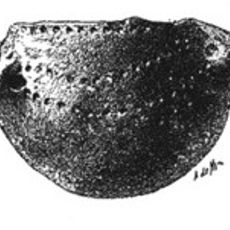
Until the mid-19th century, Arcy's winegrowers held their winter evening gatherings inside the Grotte des Fées. The cave later yielded a Hallstatt fibula found in 1993 by Jean-Claude Liger, possibly from a tomb, and it seems to have been used for several burials, including one from the Bronze Age found by Ficatier in 1889.
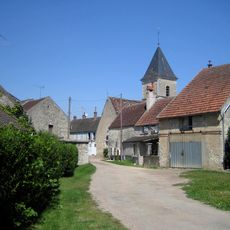
The entrance sits about 1.3 km south of Arcy-sur-Cure, roughly 380 m upstream of the Grande Grotte, on the left bank of the Cure at about 130 m altitude. The porch opens from a near-vertical fissure, so the approach crosses dusty, stony ground. The cave is a listed Monument historique and part of a network explored since 1967 by the Spéléo-Groupe Yonne-Vercors.
The cave's triangular porch comes from a near-vertical fissure, unlike the lintelled porches of the Grande grotte or the grotte de la Hyène, which were cut along joints between rock strata. Its marl bedrock, harder than limestone, has left the porch roughly intact.
The community of curious travelers
AroundUs brings together thousands of curated places, local tips, and hidden gems, enriched daily by 92,855 contributors worldwide.