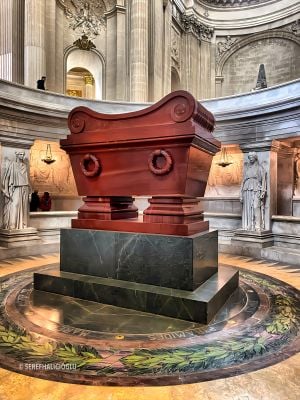
Tomb of Napoleon, tomb in the 7th arrondissement, Paris, France
The Tomb of Napoleon is an open circular crypt, about 23 metres across and nearly 6 metres deep, hollowed out beneath the dome of the Invalides. At its centre, on a green granite base over a black marble slab, stands the purple Shoksha quartzite sarcophagus, its curved top fitted with two wreath handles, set within a floor of concentric marble and enamel rings. Twelve Victory statues against pillars ring the space, and ten relief panels line the gallery wall.
The building was founded in 1670 by King Louis XIV as a home for wounded soldiers and later received the famous dome, built between 1677 and 1707 by architect Jules Hardouin-Mansart. Napoleon's remains were brought here in 1840 from the island of Saint Helena and placed in the final tomb in 1861.
The tomb is a lieu de mémoire in the sense defined by historian Pierre Nora in Les Lieux de mémoire (1984): a space where a society keeps and revives the memories tied to its history. Official ceremonies and commemorations are held here regularly, and the monument anchors the Napoleonic memory in a spatial and historical setting.
The tomb is located in the 7th district at Rue de Grenelle and is easily reached by public transport via Metro line 8 or RER line C to the Invalides station. The site is open daily from morning until evening, with extended hours on certain Friday evenings each month.
The red quartzite block, long called porphyry, was quarried in Russian Karelia in 1848 with Tsar Nicholas I's permission and shipped via Kronstadt and Le Havre, reaching Paris on 10 January 1849. Sculptor A. Seguin shaped it using steam-powered machinery.
The community of curious travelers
AroundUs brings together thousands of curated places, local tips, and hidden gems, enriched daily by 92,338 contributors worldwide.