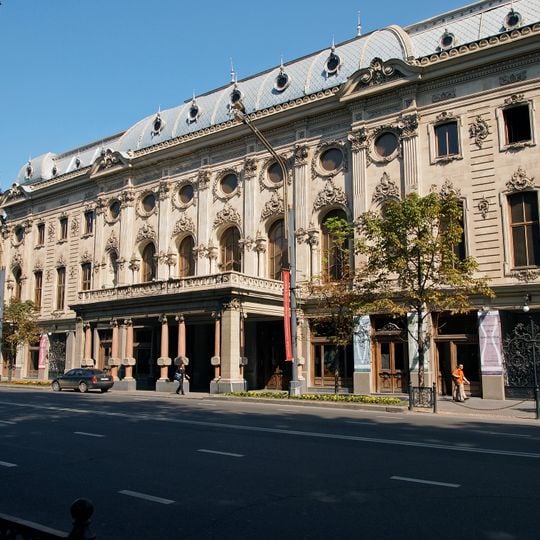
Rustaveli Theatre, National theatre in central Tbilisi, Georgia
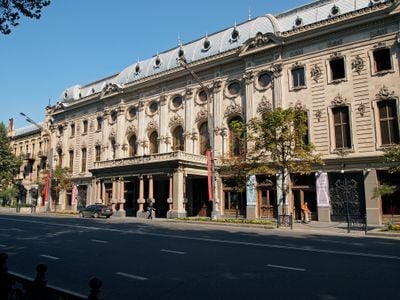
Rustaveli Theatre is a Rococo-style theatre building on Rustaveli Avenue in Tbilisi, founded in 1887 as the Artists' Society. Its light grey and tan stone facade has a deep entrance portico with paired dark columns, a long balustraded balcony above, and tall arched, round and rectangular windows between pilasters. The curved metal-clad roof carries small dormer vents. Inside are three stages: a main stage of about 800 seats, a small stage of 283 and a Black Box of 182.
Plans for the building took shape in the late 1800s when a wealthy merchant provided funding to create a centre for Georgian artists. The completed theatre soon became the city's leading performance venue and has retained that role ever since.
The theatre carries the name of Shota Rustaveli, Georgia's national poet, since 25 November 1921. Its repertoire has long mixed Georgian classics with translated Shakespeare and European drama; in 1882 Davit Eristavi's Georgian adaptation of Scribe's "Flandre" as "Samshoblo" became a landmark of the national stage. Today the company performs on three stages, including a Black Box for experimental work.
The theatre sits on a busy street in the city centre and has a ticket counter right at the entrance for visitors. Since performances happen throughout the year, visiting is worthwhile any season, but checking the schedule beforehand is a good idea.
The basement walls and ceilings were painted with frescoes by Lado Gudiashvili, David Kakabadze, Serge Sudeikin and the Toidze brothers. These were whitewashed under Soviet rule, and only a small portion has since been restored.
The community of curious travelers
AroundUs brings together thousands of curated places, local tips, and hidden gems, enriched daily by 93,160 contributors worldwide.