Ubisi monastery, Medieval monastic complex in Imereti, Georgia
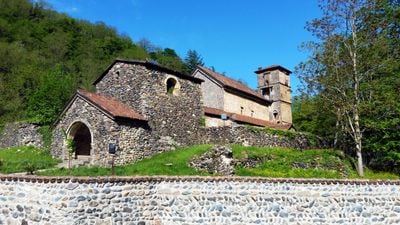
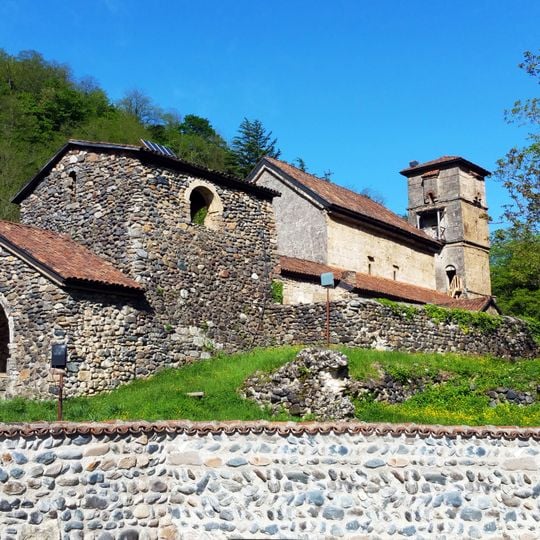
Ubisi monastery is a monastic complex in Imereti whose main church, dedicated to Saint George, was built at the turn of the 9th–10th centuries. Its four-story stone pillar, built of shirimi stone in 1141 by Simon Chqondideli, survives unaltered, with one room per floor. The complex stands on a grassy slope above the Dzirula River, with a low stone wall in front.
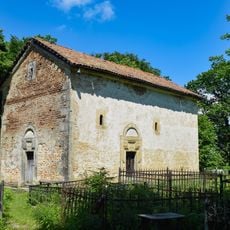
According to S. Gorgadze, the monastery was founded in the 9th century, after Georgia's liberation from Arab rule, by Grigol Khandzteli with his disciples Kristepore and Theodore, in Margveti, in the domain of the Abkhaz king Demetrius. Giorgi Merchule records that Grigol built the monastery, named it Ube, and appointed the Jerusalem-born elder Ilarion as its superior. The main church dates to the 9th–10th century boundary (R. Schmerling, 1954); Sh. Amiranashvili dated the two-nave basilica to the 12th century, when Simon Chqondideli built the tower in 1141, during the reign of Demetrius I.
The interior walls display detailed frescoes from the 14th century showing biblical scenes and moments from Saint George's life, created by painters Gerasimo and Damiane. These artworks show the skill and faith of the monks who lived here.
The monastery stands northeast of Ubisi village in Imereti, on a grassy slope above the left bank of the Dzirula River. The complex is enclosed by a low stone wall, with the main church at its centre and the four-storey stone pillar nearby. Visitors should note that the site is on uneven, sloping ground.
The four-storey pillar tower, built of shirim stone in 1141 under King Demetrius, survives unaltered, with a cellar, a living room with fireplace and latrine, a work-and-prayer room and a top defence level with embrasures. Its inscription names Simon Chqondideli, who likely spent his last years there.
The community of curious travelers
AroundUs brings together thousands of curated places, local tips, and hidden gems, enriched daily by 93,195 contributors worldwide.