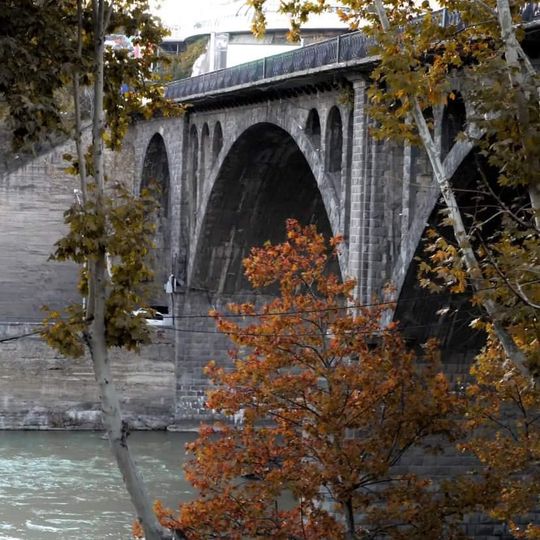
Çariça Tamar körpüsü, Arch bridge over the Kura River in Tbilisi, Georgia
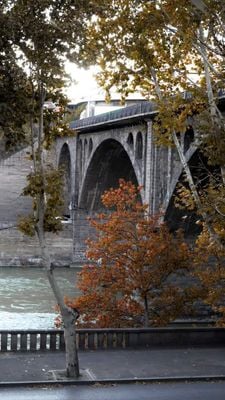
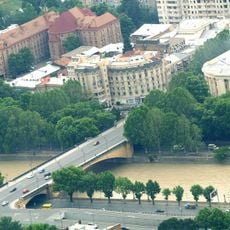
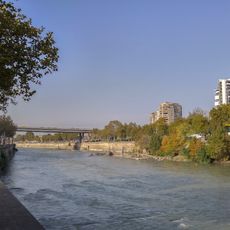
The Queen Tamar Bridge is a four-span reinforced-concrete arch bridge over the Kura River, carrying Queen Tamar Avenue and linking the railway-station area with Saburtalo, Vake and the city centre. Its two central arches cross the river, while two side arches span the embankment roads. The piers are faced with rough-hewn granite and the arch faces with dark-grey basalt blocks.
Construction began in 1932 on a design by engineers K. Zavriev and N. Slovinsky, with architecture by N. P. Severov; the bridge opened to traffic on 6 August 1935. It was first named after the Chelyuskinets street, honouring the rescue of the Soviet steamship Chelyuskin's crew. In 1989 both street and bridge were renamed after Queen Tamar.
The bridge was named after Queen Tamar in 1989, replacing its Soviet-era name Chelyuskinets, which honoured the crew of the steamship Chelyuskin. Its avenue and the bridge carry her name, linking the structure to Georgia's medieval royal past.
The bridge carries four lanes of traffic and pedestrian walkways, so cross on the designated footpaths. It spans the Kura in line with Queen Tamar Avenue, with the Vakhushti Bagrationi bridge upstream and the Galaktion Tabidze bridge downstream. The central spans have metal railings, the side spans a stone parapet.
The bridge's arches are unusually thin: at the crown of the main span the arch is only one-fiftieth of the span, a technical feat in its day. Its supports are faced with rough-hewn granite and the arch faces with dark grey basalt blocks.
The community of curious travelers
AroundUs brings together thousands of curated places, local tips, and hidden gems, enriched daily by 94,391 contributors worldwide.