Széchenyi thermal bath, Thermal bath complex in City Park, Budapest, Hungary.
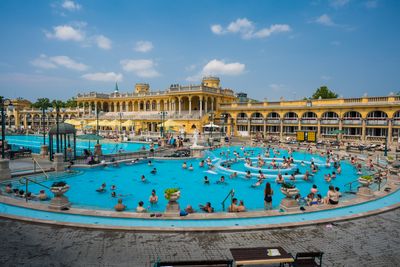
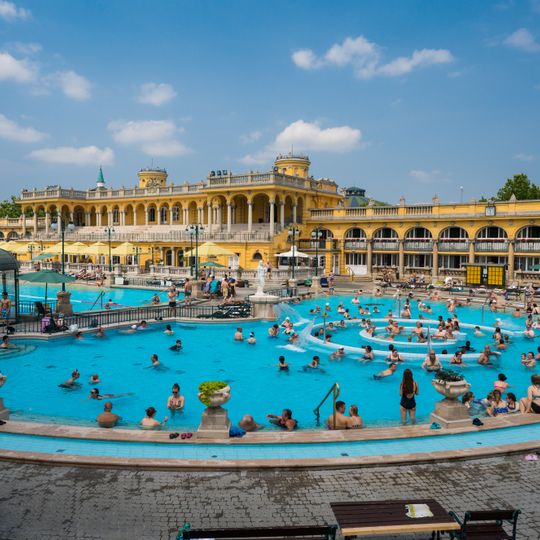
Széchenyi thermal bath is a Neo-Baroque complex in City Park, Budapest, with a yellow facade, a domed corner tower and statues along the roofline. Its central section rises in tiers: an arcade of arched openings, a loggia of slender columns and an upper colonnade. Three outdoor pools are arranged in a semicircle before the building, and the interior holds 15 pools.
Vilmos Zsigmondi drilled a 975-metre artesian well beneath City Park between 1865 and 1875. Győző Czigler drew up the plans, and construction began on 7 May 1909 under engineer Jenő Schmitterer; Czigler died in 1905 and his colleagues Ede Dvorák and Kálmán Gerster saw the building through. The bath opened on 16 June 1913 as the Széchenyi Medicinal Bath. A second well, drilled from 1936, struck 77 °C water at 1,256 metres in 1938.
The complex takes its name from politician István Széchenyi and represents centuries of Hungarian spa culture centered on mineral water drawn from deep underground sources. Locals use the pools year-round for swimming or play chess on floating boards in the warm water.
Visitors can book tickets in advance and rent towels, swimwear, or private cabins on site. Separate areas with saunas and steam rooms are located in the indoor halls and accessed through corridors.
Two natural thermal springs feed roughly 6 million liters of water daily into the complex with constant outlet temperatures of 74 and 77 degrees Celsius. The outdoor pools remain open even in winter and produce thick steam when cold air meets the hot water.
The community of curious travelers
AroundUs brings together thousands of curated places, local tips, and hidden gems, enriched daily by 92,604 contributors worldwide.