Cifra Palace, Revenue house in Kecskemét, Hungary.
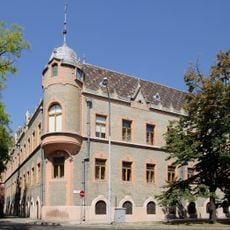
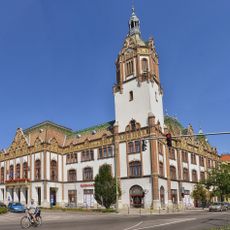
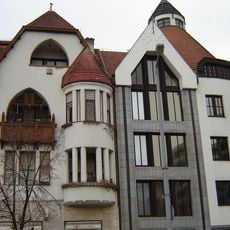
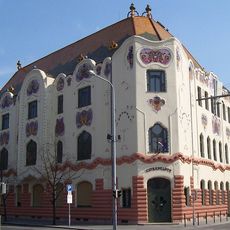
Cifra Palace is a two-storey secessionist revenue house at the corner of Rákóczi út and Szabadság tér, designed by Géza Márkus in 1902 and built in 1903. Its facade is covered in colourful majolica made by the Zsolnay porcelain factory, dominated by folk-art motifs, and closes in a wavy line beneath a tall decorated roof with green and light-brown tiles.
Géza Márkus designed the building in 1902 in the secessionist style, following the national form of Lechner; construction took place in 1903 as the city's revenue house. It originally held shops, flats and a casino. Since 1983 it has been the central exhibition site of the Kecskemét Katona József Museum.
The building houses an art collection and functions as a gallery space for the city today. Visitors can see works that were once gathered by a local art collector and later donated to public use.
The palace stands at the corner of Rákóczi út and Szabadság tér (Főtér), so it is reached on foot from the main square. The permanent Avar finds are on the first floor, temporary exhibitions on the lower level and the fine-art collection on the second floor, so plan the visit by level.
The building's exterior is covered with handcrafted ceramic tiles displaying Hungarian folk patterns, created using a traditional scratching technique. This elaborate surface decoration sets it apart from many other structures of the same era.
The community of curious travelers
AroundUs brings together thousands of curated places, local tips, and hidden gems, enriched daily by 92,783 contributors worldwide.