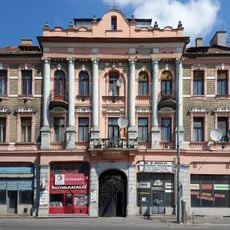
Greek Catholic Cathedral in Búza Square, Greek Catholic cathedral in Búza Square, Miskolc, Hungary
The Greek Catholic Cathedral at Búza Square is a church with a Latin-cross plan, a central projecting tower flanked by lower stair towers, and a hexagonal spire topped by a double cross donated by Miskolc's Orthodox community. Its interior has a three-bay barrel vault with Art Nouveau floral motifs and a 19-image iconostasis made in 1918 by the Rétay és Benedek workshop.
Greek Catholics of Rusyn and Slovak origin settled in Miskolc in the first half of the 18th century, and a parish was formed on 20 August 1900 under its first priest, Schirilla Szólon Andor. The foundation stone was laid on 22 May 1910 on land given by the city; the church was built to plans by Galter János and executed by builder Hricz József. It was consecrated on 15 August 1911, the feast of the Assumption, before a crowd of ten thousand. Cathedral rank came in 2011, when Miskolc again became a Greek Catholic episcopal seat and Pope Benedict XVI appointed Orosz Atanáz as bishop-exarch.
The church follows Byzantine rituals while remaining united with Rome, showing how Hungarian Greek Catholics blend Eastern and Western Christian traditions. Visitors can see this mix reflected in the interior decoration and the way services are conducted.
The church stands on Búza Square in the city centre, set back from the busy square behind a walled courtyard whose inner wall carries scenes from the life of the Virgin Mary and images of Saints Cosmas and Damian, Saint Stephen, Saint Piroska and Bishop Hierotheos. The bells ring together for one minute at the start of the Divine Liturgy, and the large bell sounds for three minutes in the morning, at noon and in the evening.
The tower's hexagonal spire carries a double cross donated by Miskolc's Orthodox community. According to the story, the Orthodox church roof was damaged in an 1875 storm and the Serbian king funded repairs; the cross arrived so late that the tower was already finished, so it was given to this church. The great bell, cast in Sopron in 1912, is the only one to survive both world wars.
The community of curious travelers
AroundUs brings together thousands of curated places, local tips, and hidden gems, enriched daily by 94,668 contributors worldwide.