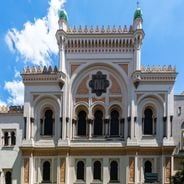
Synagogue of Miskolc, Orthodox synagogue in Kazinczy Street, Miskolc, Hungary.
The Synagogue of Miskolc, at Kazinczy utca 7, was designed by Ludwig Förster in Romanesque Revival and Rundbogenstil styles. Its Kazinczy Street facade has an arabesque rose window and narrow arched windows; the courtyard facade shows Moses' two stone tablets. Inside, a three-aisle hall has slim iron pillars with Gothic and Byzantine ornament, and M. Horowitz painted the walls with complex Eastern motifs.
Ludwig Förster designed the synagogue, built between 1856 and 1862 in Romanesque Revival and Rundbogenstil styles. His innovations, an organ and the reader's platform placed before the Ark, were rejected by the Orthodox majority; a rabbinical assembly in Sátoraljaújhely excommunicated the Miskolc rabbi, and the organ was removed and the platform returned to the centre. The dispute split the community, with local Hasidim separating and building a prayer house on Kölcsey Street that no longer survives.
Marble tablets at the Déryné Street entrance commemorate the local Jews killed in the Holocaust; further plaques stand in Arany János Street, on the site of the former ghetto, and at the Tiszai railway station. About 10,000 Jewish residents lived in Miskolc in 1920, 16.5% of the population, and roughly 500 remained in 2001.
This remains the only functioning Jewish house of worship in Borsod-Abaúj-Zemplén county, serving roughly 500 members of the local community. Visitors should be aware that this is an active place of religious practice.
The wall paintings with ornamental Eastern motifs are the work of M. Horowitz. On the courtyard-facing main façade, the two stone tablets of Moses are carved, a detail easily missed from Kazinczy Street itself.
The community of curious travelers
AroundUs brings together thousands of curated places, local tips, and hidden gems, enriched daily by 92,656 contributors worldwide.