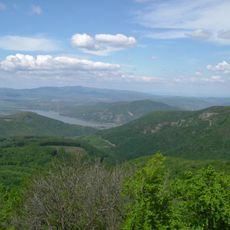
Vadálló-kövek, Rock formation summit in Komárom-Esztergom County, Hungary.
Vadálló-kövek is a group of volcanic rock formations in the Visegrád Mountains, administratively part of Dömös. Its base rock is andesite, formed by volcanic activity about 12 million years ago. The formations are quite crumbly and lie in a remote spot, and three small caves open in them: the Átjáró-barlang, the Fali-fülke and the Vadálló-kői-fülke.
The andesite of Vadálló-kövek formed during volcanic activity about 12 million years ago. In the early 20th century Hungarian mountaineers used the unstable, remote rock formations as a climbing school. The site belongs administratively to Dömös, and the rocks, together with Prédikálószék, are a strictly protected part of Duna–Ipoly National Park and the core zone of a biosphere reserve.
The rocks belong to the Duna–Ipoly National Park and form the core zone of a biosphere reserve, together with Prédikálószék. Hungarian climbers used the unstable, remote formations as a climbing school mainly in the early 20th century. Three small caves are listed here: Átjáró-barlang, Fali-fülke and Vadálló-kői-fülke.
Visitors can reach the site via marked trails from Szentfa Chapel, with the hike taking around 90 minutes to reach the main viewing points. Good footwear and water are important since the path goes over rocks and alternates between shaded areas and sun-exposed sections.
The rock is andesite, formed by volcanic activity about 12 million years ago. In the early 20th century, Hungarian climbers used these unstable, remote crags as a climbing school. Three small cavities open in the rock: the Átjáró-barlang, the Fali-fülke and the Vadálló-kői-fülke.
The community of curious travelers
AroundUs brings together thousands of curated places, local tips, and hidden gems, enriched daily by 94,354 contributors worldwide.