Szeged Town Hall, Baroque Revival town hall in Szeged, Hungary.
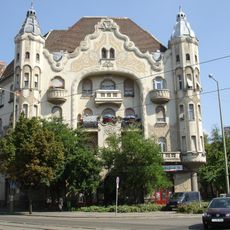
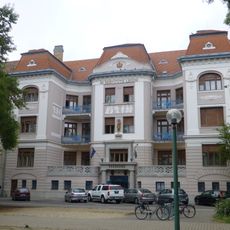
Szeged Town Hall is an administrative building in the city center designed in Baroque Revival style with elaborate ornamental details. The facade displays carved moldings, domed sections, and tall columns that create its impressive exterior appearance.
The first town hall was completed in 1728 and rebuilt between 1799 and 1805 to plans by Vedres István. In July 1849 the parliament meeting here twice enacted Jewish emancipation and the minority law; on 5 August Haynau watched the Battle of Szőreg from the old tower and a Hungarian cannonball nearly hit him, lodging in the wall. After the 1879 flood the centre was raised and in 1883 a new storey was added, the building remodelled in eclectic neo-baroque style by Lechner Ödön and Pártos Gyula.
The council chamber walls carry portraits of Queen Elisabeth, King Franz Joseph I, Kálmán Tisza and Lajos Tisza, and the ceiling fresco shows angels raising Szeged's coat of arms. The hall also serves as a wedding room, and every hour the tower's bells play popular melodies, among them "Valahol a Volga mentén".
The town hall stands at Széchenyi tér 10, on the city's main square, and the municipal council meets in the ceremonial hall, which also serves as a wedding venue. The building is a listed monument, so visitors should check opening conditions before planning to enter.
The tower's hourly chime plays popular melodies, including "Valahol a Volga mentén". Babits Mihály, who began his career in Szeged, likened the tower with its surrounding balcony to a graceful dancer wearing her lace coquettishly.
The community of curious travelers
AroundUs brings together thousands of curated places, local tips, and hidden gems, enriched daily by 93,295 contributors worldwide.