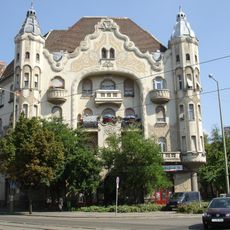
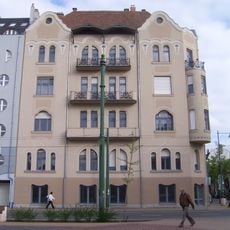
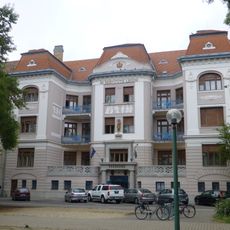
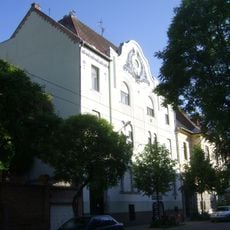
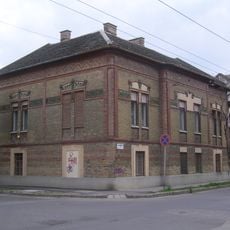
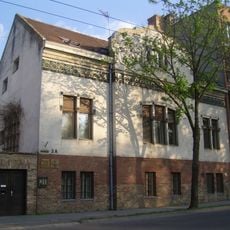
Vasalóház, Secessionist architecture edifice in Szeged, Hungary.
Vasalóház is a secessionist building erected in 1912–1913 to plans by Lipót Baumhorn, named for its unusual shape, which resembles a flat iron. Its main entrance opens from Takaréktár utca, with a second entrance on Horváth Mihály utca. The ground floor holds ten shops with storerooms and a caretaker's flat, a mezzanine level has 17 offices, and the upper floor contains three- and five-room apartments.
Architect Lipót Baumhorn designed this building in 1913 during a period when Hungary was developing its own architectural identity. The secessionist style aimed to distinguish itself from Austrian traditions and emphasize Hungarian character.
The name Vasalóház means "iron house", referring to the building's shape rather than to any laundry. Its wedge-like form, which earned it the nickname, is what residents named it after. The main entrance opens from Takaréktár utca, with a second entrance on Horváth Mihály utca.
Vasalóház has two entrances: the main one on Takaréktár utca and a second on Horváth Mihály utca. The ground floor holds ten shops with storerooms and the caretaker's flat, while 17 offices fill the mezzanine and three- to five-room flats the upper floor. Look up from the pavement to read the iron-shaped outline against the sky.
Unlike contemporary Viennese secessionist buildings, Baumhorn deliberately integrated Hungarian decorative patterns and local design elements. This conscious departure from Austrian aesthetics makes the house an early example of cultural independence in Hungarian architecture.
The community of curious travelers
AroundUs brings together thousands of curated places, local tips, and hidden gems, enriched daily by 93,730 contributors worldwide.