Sárkányfürdő Cave, Erosion cavity in Ecseg, Hungary
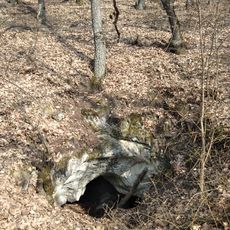
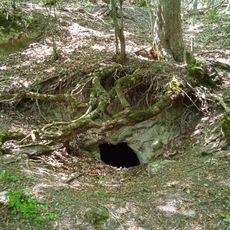
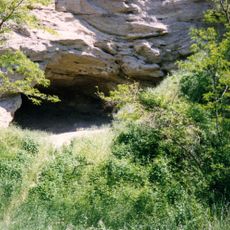
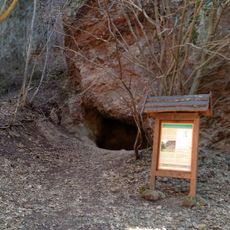
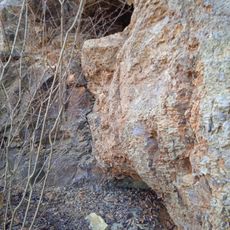
Sárkányfürdő Cave is a 2.05 m long erosion niche in compact augite andesite on the side of a rocky meander of the Cserkúti stream, about 240 m above sea level. Its entrance, 2.3 m wide and 1.65 m high, faces southwest, and the floor slopes down inside, covered with stone debris and muddy sediment. The ceiling drops stepwise to 80 cm.
The cavity was first recorded under the name Sárkányfürdő-barlang in 1988, in the yearbook of the Alba Regia Barlangkutató Csoport. Members found it on the guidance of Ribár Balázs, a local resident of Ribártanya (also called Szigethi malom), and heard the name from him. Local people knew the niche earlier, but no specialist or tourist publication had mentioned it. István Eszterhás surveyed it on 20 August 1988.
The name Sárkányfürdő, meaning "Dragon Bath," was heard by researchers from Ribár Balázs, a local resident of Ribártanya (also called Szigethi mill), when they found the cavity in 1988. Local people knew the spot before it appeared in any publication. The name first appeared in writing in the 1988 yearbook of the Alba Regia Cave Research Group.
The cavity lies in the rocky bed of the Cserkúti stream at about 240 m above sea level, 3 km northwest of Ecseg, near the ford where the cart road crosses the stream. From Ribártanya (Szigethi mill) follow the cart road about 2 km into the Cserkúti valley. When the stream is dry the niche can be viewed without equipment; in wet periods water fills a third to a half of it.
The cave is only 2.05 m long and just exceeds the minimum size for a cave; its height drops stepwise from the entrance to 80 cm. Caddisfly cases of Beraeodes minutus, 6–8 mm long, cling to the niche wall, and larger 2–3 cm stone-built cases of Stenophylax stellatus lie on the floor stones.
The community of curious travelers
AroundUs brings together thousands of curated places, local tips, and hidden gems, enriched daily by 94,096 contributors worldwide.