Dún Ailinne, Iron Age hillfort in County Kildare, Ireland
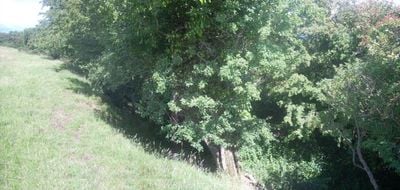
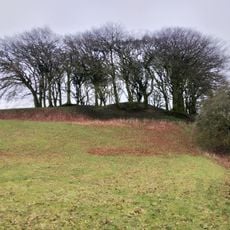
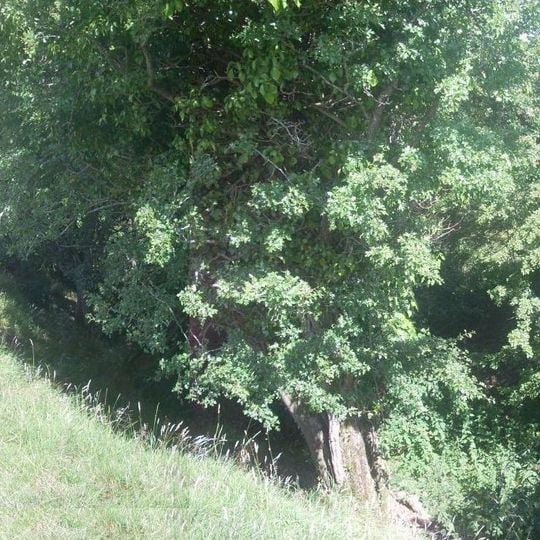
Dún Ailinne is a circular enclosure of about 13 hectares covering most of the hilltop of Cnoc Ailinne (Knockaulin), southwest of Kilcullen near the R418 road to Athy. An earth bank and ditch ring the site, with the ditch on the inside, which suggests a symbolic rather than defensive role. Nothing now stands above ground; the photograph shows only a leafy tree, grass and a green slope, and the bank and ditch are hard to make out.
The site was built starting around 400 BCE and underwent several major renovations and reconstructions over roughly 8 centuries. Archaeological evidence suggests it served as a center of power and influence throughout the Iron Age period.
In early Irish literature Dún Ailinne is named as one of the royal sites of Gaelic Ireland, and medieval texts held that the Kings of Leinster were inaugurated there, though they were written long after the site's main use. Excavation found three phases of timber rings, including the figure-of-eight Rose phase and the stakewalled Mauve phase, and the last phase left quantities of cattle, sheep, pig, deer and horse bone from feasting. A La Tène-style sword and Roman bronze fibulae were also found.
The site sits on private farmland and you need permission from the landowner before visiting as livestock graze on the hillside. Plan your visit early in the day when lighting is best for seeing the earthwork details and the hill is quieter.
The 2008 interpretative site at Nicholastown, south of Kilcullen, has a bilingual Irish-English panel and a small-scale model of the hill topped by a sculpture. The hill itself rises to 183 m and is best seen from the Old Kilcullen churchyard, which has a round tower. Dún Ailinne is not the Hill of Allen (Cnoc Alúine) to the northwest.
The community of curious travelers
AroundUs brings together thousands of curated places, local tips, and hidden gems, enriched daily by 93,696 contributors worldwide.