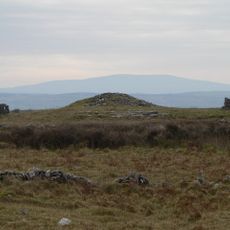
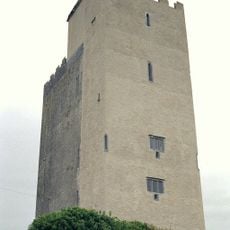
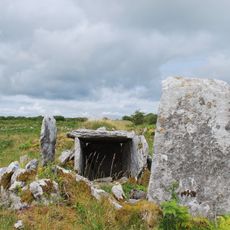
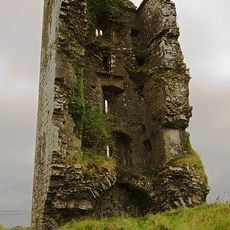
Cahercommaun, Triple stone ringfort in County Clare, Ireland
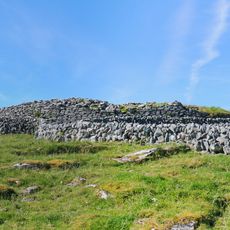
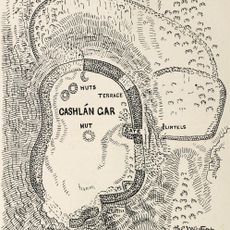
Cahercommaun is a triple stone ringfort on the south-east edge of the Burren, near Carran in County Clare, built in the 9th century on an inland cliff above a wooded valley. Its innermost wall, 5 ft thick and rising 12 to 14 ft above the cliff, forms an almost complete circle and holds three chambers; the two outer walls, linked by radial walls, form only a semicircle. The outer enclosure measures about 350 ft east-west by 245 ft north-south.
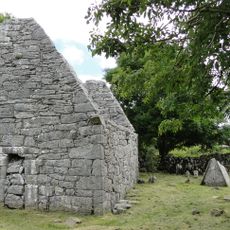
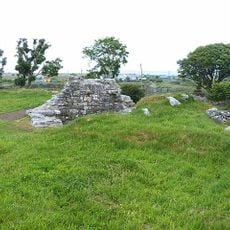
Archaeological work starting in 1934 uncovered ruins of stone buildings dating to the 9th century within the fort's walls. These findings showed the site functioned as a defended settlement that housed multiple families during the medieval period.
Archaeological discoveries at the site include a silver brooch from the 9th century, now displayed at the National Museum of Ireland in Dublin.
Cahercommaun stands on the south-east edge of the Burren, reached by minor roads from Carran and Kilnaboy; the outermost wall measures about 350 ft east-west by 245 ft north-south. The ground inside is uneven and the cliff edge drops to the north, so keep to the visible tracks and watch footing on loose stone. The inner wall rises 12 to 14 ft above the cliff.
The 1934 Harvard excavation found the Tullycommon bone, bearing two Ogham inscriptions, among the remains inside the fort. The dig also recovered 55 spindle whorls and iron shears, and animal bones that had raised the floor about 1.5 m above the bedrock.
The community of curious travelers
AroundUs brings together thousands of curated places, local tips, and hidden gems, enriched daily by 92,759 contributors worldwide.