St Andrew's Church, Dublin, Gothic Revival church in Dublin, Ireland
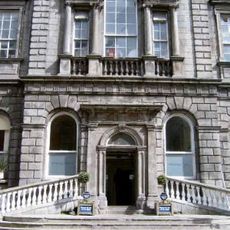
St Andrew's Church is a Gothic Revival structure on St Andrew Street featuring a four-stage tower with an octagonal corner turret that rises prominently above the street. The interior contains a four-bay nave flanked by side aisles that organise the main worship space.
The first St Andrew's stood on present-day Dame Street and vanished under Oliver Cromwell in the mid-17th century. A replacement went up around 1670–1674 on a former bowling green near the Thingmote, designed by William Dodson and nicknamed the "round church". Rebuilt in Georgian style from 1793 to 1807 to a design by Francis Johnston, it burned in 1860 and the present Gothic structure was built around 1862.
The church is named for Saint Andrew, whose feast is kept on 30 November. Vanessa, the former pupil of Jonathan Swift, was buried here in June 1723, and the Lord Chancellor Thomas Dalton in 1730. The Italian violinist and composer Francesco Geminiani was buried in the churchyard in September 1762; his remains were moved to San Francesco in Lucca, his birthplace, in 1929.
The former church stands on St Andrew's Street, a short walk from Dame Street and Trinity College, with the Molly Malone statue in neighbouring Suffolk Street as a nearby landmark. It ceased to be a church in 1995, housed Fáilte Ireland's Dublin tourist office until 2014, and was later redeveloped with a view to reopening as a food hall, so its doors open according to that use rather than for worship.
The church stands on a site once occupied by a bowling green near the Thingmote, the assembly place of Dublin's Norse rulers. Local landlords Lord Anglesey and John Temple served as churchwardens; Anglesey Street and the Temple Bar district carry their names.
The community of curious travelers
AroundUs brings together thousands of curated places, local tips, and hidden gems, enriched daily by 92,607 contributors worldwide.