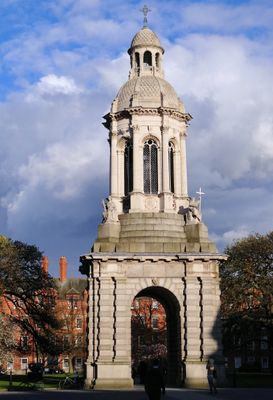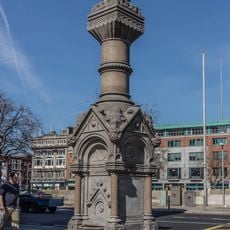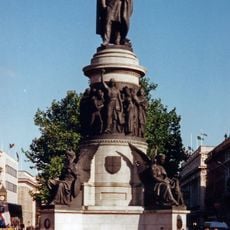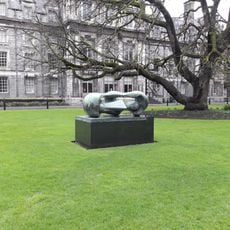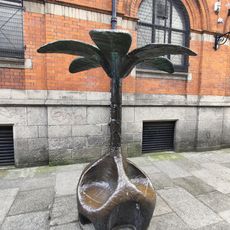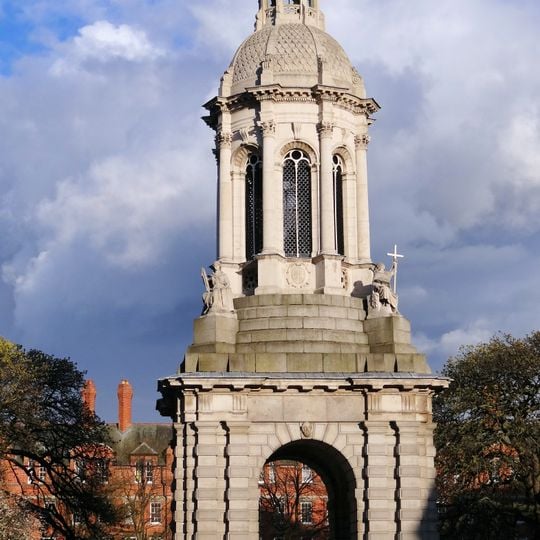
Campanile, Bell tower at Trinity College, Dublin, Ireland.
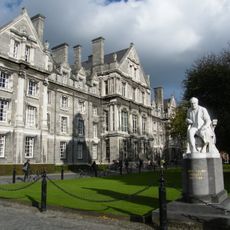
Campanile is a 30.5-metre bell tower of granite and Portland stone, standing on the central axis of Library Square at Trinity College Dublin. Its base has paired Doric pilasters and four round-headed arches whose keystones are carved with heads of Homer, Socrates, Plato and Demosthenes. Above, a cylindrical belfry ringed by Corinthian columns carries two scale-patterned domes and a gilded cross.
The Campanile is the latest in a line of bell towers begun by the monastery of All Hallows. It replaced a tower designed by Richard Castle in 1740-46, whose unsafe upper belfry was removed around 1791 and the rest demolished in 1798. Its foundation stone was laid on 1 December 1852, and the tower, designed by Charles Lanyon and sculpted by Thomas Kirk, was finished in 1854, paid for by Archbishop John Beresford.
The keystones of the four ground arches carry carved heads of Homer, Socrates, Plato and Demosthenes, standing for the liberal arts. At the corners, Thomas Kirk's Portland stone figures of Divinity, Science, Medicine and Law sit on a stepped granite base. The Great Bell is chimed rather than swung before degree conferrals and examinations.
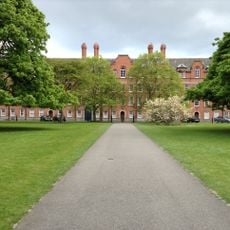
The Campanile stands on the central axis of Library Square, not the geometric middle of the college, which is the Museum Building; the Front Gate and Regent House lie to its west. The Great Bell inside weighs thirty-seven hundredweight and is too large to swing, so it is chimed instead. It rings before degree conferrals and tolls before examinations.
Four carved coats of arms sit at the base of the tower, representing the United Kingdom, Trinity College Dublin, Lord John Beresford, and the Archbishopric of Armagh. These reliefs record the key figures and institutions involved in creating the tower.
The community of curious travelers
AroundUs brings together thousands of curated places, local tips, and hidden gems, enriched daily by 92,784 contributors worldwide.