O'Connell Bridge, Road and tram bridge across River Liffey, Dublin, Ireland
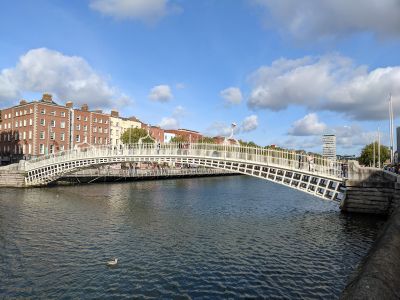
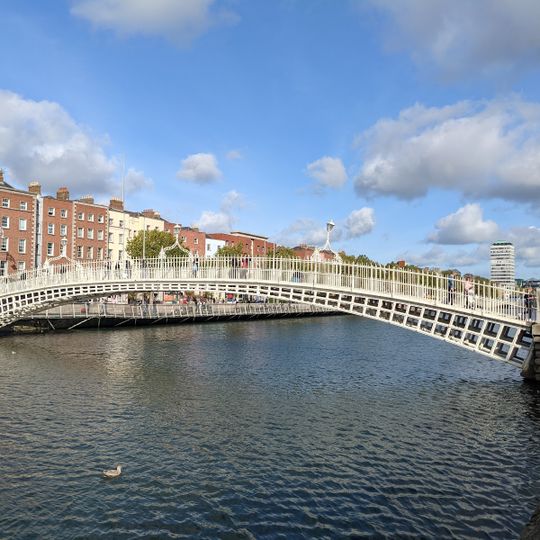
O'Connell Bridge spans the River Liffey, joining O'Connell Street to D'Olier Street, Westmoreland Street and the south quays. It is a symmetrical structure of three semicircular granite arches with a Portland stone balustrade and obelisks at its four corners. It is about 50 m wide and 45 m long, and carries road traffic, trams and pedestrians.
James Gandon designed the original Carlisle Bridge, built between 1791 and 1794 as a humped, three-arch granite crossing named after Lord Lieutenant Frederick Howard, 5th Earl of Carlisle. It was widened and reconstructed between 1877 and 1880 to match Sackville Street's 70-metre width, and when reopened around 1882 it was renamed for Daniel O'Connell as his statue was unveiled.
Arthur Fields, known as The Man on The Bridge, photographed over 182,000 pedestrians here from the 1930s to the 1980s. The bridge also appears in Liam O'Flaherty's short story The Sniper and James Joyce's Ulysses. A plaque dedicated to the fictitious Father Pat Noise was installed by pranksters in 2004 and remained unnoticed until 2006.
The bridge is easily walkable with multiple entry and exit points for different types of traffic. Crossing is most comfortable during quieter times of day, such as early morning or evening.
The keystone head at the apex of the central arch represents the River Liffey, matching the river heads on James Gandon's Custom House. In 2004 pranksters fixed a plaque to Father Pat Noise on the bridge; it stayed unnoticed until May 2006 and was still there in 2020.
The community of curious travelers
AroundUs brings together thousands of curated places, local tips, and hidden gems, enriched daily by 92,592 contributors worldwide.