Baily Lighthouse, Lighthouse on Howth Head, County Dublin, Ireland
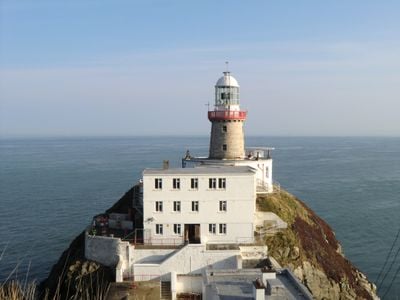
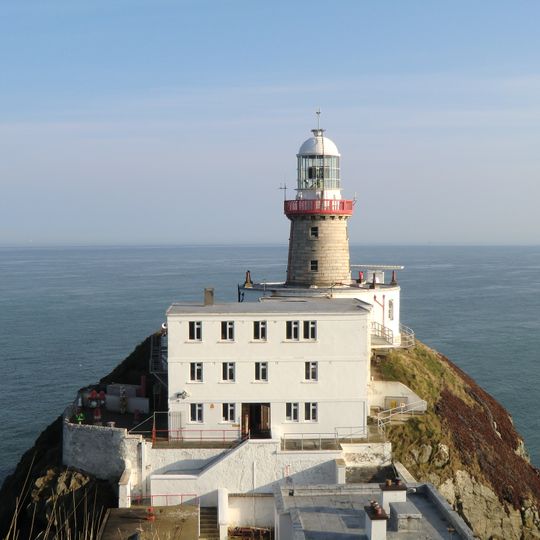
Baily Lighthouse stands on the southeastern tip of Howth Head, County Dublin. Its white three-storey base building has a flat roof, with a rectangular white annex of tall windows beside it. Above rises a cylindrical stone tower banded in grey masonry, topped by a red-painted gallery and a glass lantern room with a domed metal cap. The tower top is 41 metres above the sea.
Sir Robert Reading built the first lighthouse here around 1667, a cottage with a square coal-fired tower. Fog often hid its light, so in 1811 the station was moved south to Little Baily, where George Halpin Senior's new tower and keeper's house were finished on 17 March 1814, with the tower top 41 metres above the sea. The PS Queen Victoria wreck of 15 February 1853, in which over 80 people died, led to a fog bell being installed in April 1853.
The Irish name is Teach Solais Dhún Criofainn. The station's optic, in use from 1902 to 1972, is displayed at the National Maritime Museum of Ireland, and a small museum in the reworked buildings holds artefacts from retired staff, open by arrangement. Letitia Elizabeth Landon's 1834 poem Howth Light-House reflects on the light's role in protecting shipping.
The lighthouse grounds are accessible via the Howth Cliff Path Loop, which offers several viewing angles along the walking route. The trail follows natural paths with some steep sections, so wear sturdy shoes and be prepared for strong winds on the exposed headland.
The optic used from 1902 to 1972 is displayed at the National Maritime Museum of Ireland in Dún Laoghaire. A small museum set up in 2000 in the reworked buildings holds artefacts gathered from retired staff, and opens only by arrangement for former keepers, their families and small interest groups.
The community of curious travelers
AroundUs brings together thousands of curated places, local tips, and hidden gems, enriched daily by 92,628 contributors worldwide.