Gallarus Oratory, Early Christian chapel in County Kerry, Ireland
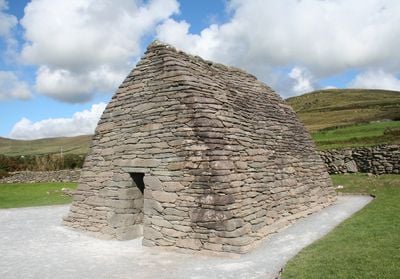
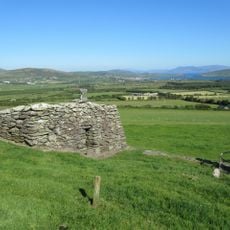
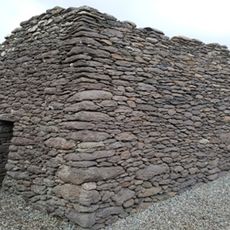
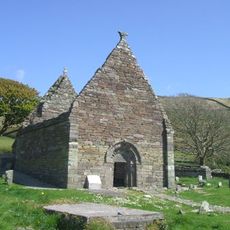
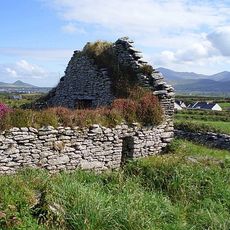
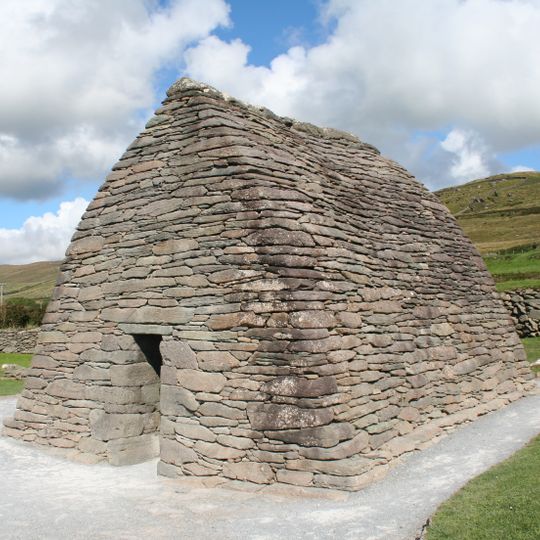
Gallarus Oratory is an early Christian chapel in County Kerry built with precisely fitted stones and a corbelled roof. The walls slope inward to create a pointed shape resembling an overturned boat.
Charles Smith gave the first known account of Gallarus Oratory in 1756, calling it an early Christian stone church; local tradition then held that Griffith More built it as a family funerary chapel. In 1970 Peter Harbison argued for a 12th-century date, partly from the two carved stones forming the rounded east window, then in 1994 proposed it sheltered pilgrims. Trial cuttings in November 1970 found nothing datable.
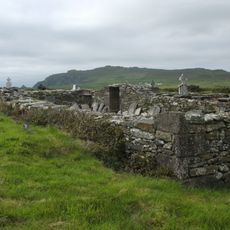
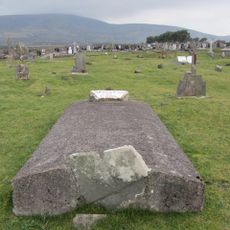
Local tradition recorded in the 1750s held that the chapel was built by Griffith More or his family as a burial place; a nearby grave was shown to travellers as the tomb of the Giant. The name Gallarus is disputed: Peter Harbison read it as 'house or shelter of the foreigner(s)', meaning pilgrims from outside the peninsula, while Pádraig Ó Siochfhradha took it as 'rocky headland'.
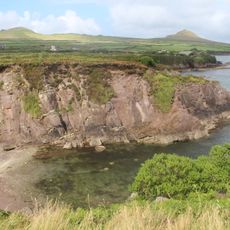
The oratory stands on a gravel patch on the hillside above Ard na Caithne harbour, reached by a short path from the car park. The doorway is only 1.67 m high with a flat lintel, so taller visitors stoop to enter. The interior is dim, lit only by the small east window, and the floor is uneven stone. The Saints' Road pilgrimage route to Mount Brandon passes less than 300 m away.
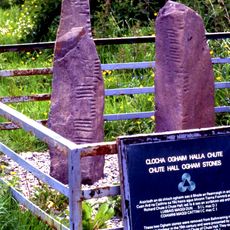
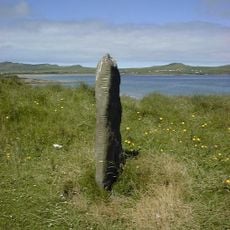
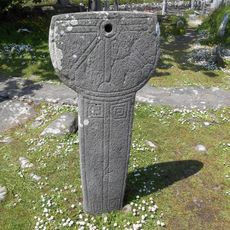
Two holed stones project from the inner wall above the lintel, possibly for hanging a wooden door. A pillar stone with the Ogham inscription "Colum Mac Dinet" stands nearby on a low rectangular mound. Vance R. Tiede of Yale University argued the east window aligns with the sun on 17 March and 31 August.
The community of curious travelers
AroundUs brings together thousands of curated places, local tips, and hidden gems, enriched daily by 92,626 contributors worldwide.